Today's
EarthStation1.com 15% Off Commemorative Memorial Title: TV
Commercials: The Cable Age Classics Vol. 4 MP4 Video Download DVD
Today, April 21, 2026
April 21: National Tea Day: -- There is
nothing more classically British than afternoon tea, which makes
this day a wildly popular occasion in the country. This love of
tea dates back centuries and this fondness seems to only get
stronger with time! National Tea Day's slogan is "Brew More.
Do More." The vision is to inspire special moments with tea.
Working with a variety of partner companies throughout the year,
they desire to bring tea drinkers, tea servers and the entire tea
industry together. National Tea Day is more than simply a holiday.
It's a movement providing opportunities for future generations of
tea drinkers to understand and appreciate the world of tea.
Founded in 2016, the date of April 21 was chosen because it is
also Queen Elizabeth's birthday! Could the day be any more
British? It's relatively common knowledge that we have the Chinese
to thank for tea, but it was actually a Portugese woman named
Catherine of Braganza who popularized the beverage in England. In
1662, Catherine married King Charles II. Her dowry included
several crates of loose leaf tea, which she continued drinking
every day in the U.K. The royal court quickly adopted the
tea-drinking process, including aristocrats. While the goal of
National Tea Day is to inspire the world to drink more tea and to
drink it throughout the year, we can't help but immediately think
of the famous British afternoon tea. "Tea" can be both a
drink and a meal. The Duchess of Bedford, Anna Russell, introduced
afternoon tea during the late 1840's out of her hunger pains
between the two daily meals at the time, which she shared with
friends. Many forms of tea exist around the world. Green tea is
popular in countries such as China and Japan, whereas South Asian
countries often prepare 'chai' with spices, boiled in both milk
and water. There is even a pink tea, commonly known as 'Kashmiri
tea,' served in many parts of the Himaylan regions of Pakistan and
Afghanistan during the winter months at weddings. In the UK, the
perfect British cuppa is usually served as a variety of black tea
with boiling water and a little milk. Henry James, author and
nominee for a Nobel Prize in Literature, once said, "There
are few hours in life more agreeable than the hour dedicated to
the ceremony known as afternoon tea." National Tea Day
celebrates the world's second favorite drink - only to water - so
heavily stemmed in everyday culture so each of us can learn and
revel in its drinking experience! On Sale @ 15% Off Discount Till
Midnight PT!
https://store.earthstation1.com/tv-commercials-the-cable-age-classics-vol-4-mp4-video-download-d44.html
Today's
EarthStation1.com 15% Off Commemorative Memorial Title: TV
Commercials: The Classics Vol. 9 DVD, MP4 Download, USB Flash
Drive
Today, April 21, 2026
April 21: Tuna Rights Day: -- The point
of this holiday is to raise awareness about the importance of tuna
and tuna-like fish in our ecosystem. They are not just
nutrient-rich food sources, but also an integral part of the
marine food chain. Due to the heightened demand for tuna for human
consumption, the tuna population is being depleted at
unsustainable levels. World Tuna Day has been celebrated for the
same reason as Tuna Rights Day since 2016. These days highlight
the importance of the mindful consumption of sustainably-sourced
tuna wherever possible. Tuna has been fished and consumed by
people for thousands of years. One of the first mentions of tuna
was in 350 B.C. by Greek philosopher Aristotle in his work
"History of Animals." Ancient Roman author Pliny the
Elder recommended eating tuna to treat ulcers. Tuna has also been
an integral part of the diets of the Japanese and Pacific
Islanders since the 18th and 19th centuries. There are over a
dozen species of tuna. This availability of different species
spurred the establishment of tuna fisheries across the world,
wherever certain species were most abundant. By the early 1900s,
humans were trying to perfect the process of canning fish. Initial
attempts to can sardines weren't very popular, so Albert P.
Halfhill, co-founder of the Southern California Fish Company,
decided to switch them out for albacore tuna. Canned tuna became a
near-instant hit with consumers after its sale began in 1904. By
the 1930s, Albacore tuna were nowhere to be found, seemingly
disappearing from the coast of California altogether, thus forcing
fishermen to look for tuna supplies elsewhere. During the Second
World War, tuna boats were used to deliver supplies, and the U.S.
had begun shipping canned tuna to American soldiers stationed in
other countries. By 1954, the U.S. was the world's biggest
producer of canned tuna. Today, overfishing has been recognized as
a major threat to the ecological stability of the world. The rapid
consumption of tuna now threatens to disrupt the marine food
chain. Skipjack yellowfin, Atlantic bluefin, Southern bluefin,
Pacific bluefin, big-eye, and Albacore tuna were recognized as
being either overexploited or endangered in a 2007 United Nations
report. On Sale @ 15% Off Discount Till Midnight PT!
https://store.earthstation1.com/tv-commercials-the-classics-vol-9-dv9.html
Today's
EarthStation1.com 15% Off Commemorative Memorial Title:
Washington, D.C. History Video Set DVD, MP4 Download, USB Flash
Drive
Today, April 21, 2026
April 21: Thank You For Libraries Day: --
Celebrated annually to appreciate the contribution of libraries to
society and their roles in transforming lives. Did you know that
the first systematically organized library in the world dates back
to the 7th century B.C.? Libraries are a collection of materials,
books, or media that are accessible by the public. Libraries are a
repository of knowledge, providing opportunities for learning and
supporting literacy and education. In most communities, they are
the center of art and culture and help drive creativity and
innovation. There are currently over 110000 libraries spread
across the United States. According to historians, the birth of
libraries marked the end of prehistory and the start of history.
The first libraries were nothing more than archives for commercial
transactions or inventory records. The first libraries appeared in
Southwest Asia's Fertile Crescent, which ran from Mesopotamia to
the Nile in Africa about 5,000 years ago. This same area was also
the birthplace of writing before 3000 B.C. These libraries
contained records written on clay tablets, stacked on edge, side
by side. Libraries of the same nature were found in several
regions, including Ugarit, China, Nippur, and Nineveh. In the 3rd
century B.C., the construction of the Library of Alexandria in
Egypt began. The project was sponsored either by Ptolemy I Soter
(323 B.C. to 283 B.C.) or his son Ptolemy II (283 B.C. to 246
B.C.). The library became the largest and most significant great
library of the ancient world until the Roman conquest in 30 B.C.
During this period, the Han Dynasty created three libraries, which
featured the first library classification system. During the
Greco-Roman period, libraries thrived under the patronage of
wealthy citizens and each succeeding Roman emperor. Asinius Pollio
established the first public library in Rome, and his successors
added to the number. After the fall of the Roman Empire, the
Christian Church became the new power in Europe. Hellenistic texts
thought to be pagan were left to decay, and only those related to
Christianity survived. However, that was different in Eastern
Europe, where monks labored day and night in scriptoriums to
preserve Classical Greek and Roman works. In the Muslim world,
libraries flourished as the Chinese art of papermaking was
acquired. Under the patronage of caliphs and Muslim leaders,
important Islamic cities, such as Baghdad, became centers of
knowledge and scholarship. Between the Renaissance and
Enlightenment eras, libraries began appearing in some parts of
Europe, including Italy and Hungary. These libraries serve as a
center for scholars of renown to congregate. Most of these
libraries were endowed by prominent individuals, including kings,
queens, and popes. At the start of the 18th century, libraries
became increasingly open to the public, allowing people to loan
books. In 1833, the first tax-supported public library in the U.S.
was established in Peterborough, New Hampshire. The library was a
joint effort by the Peterborough Town Meeting and state funds from
the State Literary Fund. Between the 19th century and late 20th
century, the number of public libraries drastically increased with
the support of philanthropists and businessmen, including John
Passmore Edwards, Henry Tate, Andrew Carnegie, and Bill and
Melinda Gates. In the 21st century, libraries moved from only
offering physical collections to providing access to digital
resources, including e-books and internet services. On Sale @ 15%
Off Discount Till Midnight PT!
https://store.earthstation1.com/washington-dc-history-videos-dvd-mp4-download-usb-driv4.html
Today's
EarthStation1.com 15% Off Commemorative Memorial Title: Remember
When: It'll Never Fly w/ Dick Cavett Inventions DVD, MP4, USB
Today, April 21, 2026
April 21: World Creativity And Innovation
Day: -- Creates awareness about the importance of creativity and
innovation in all aspects of human development. The day was
adopted by a resolution of the United Nations (U.N.) and
designated for April 21 in 2018. Creativity and innovation are
also vital in achieving the sustainable development goals set out
by the U.N. Though both terms are often used interchangeably,
creativity and innovation are distinct concepts that work hand in
hand to achieve the desired end. World Creativity and Innovation
Day was already being observed by citizens and organizations in
over 50 countries since 2002. The United Nations (U.N.) formally
established the day to promote the importance of creativity and
innovation in all aspects of human development, both at the
individual and group levels. According to the U.N. website -
"There may be no universal understanding of creativity. The
concept is open to interpretation from artistic expression to
problem-solving in the context of economic, social and sustainable
development." This day also highlights the importance of
applying creativity and innovation to problem-solving with respect
to economic, social, and sustainable development. According to
Encyclopedia Britannica, creativity is - "the ability to make
or otherwise bring into existence something new, whether a new
solution to a problem, a new method or device, or a new artistic
object or form." According to Merriam Webster, innovation
refers to "a new idea, method, or device." Though
creativity and innovation are two interlinked concepts, they are
two sides of a coin. Creativity is mental in nature, it involves
the thought process. It involves conceiving new ideas or new spins
on old ideas. Innovation, on the other hand, is actionable. It
involves implementing ideas to produce something useful. Both
concepts depend on each other. Innovation stems from creativity
while creativity would be fruitless without innovation. On Sale @
15% Off Discount Till Midnight PT!
https://store.earthstation1.com/remember-when-it39ll-never-fly-dvd-technology-history-dick-cave39.html
Today's
EarthStation1.com 15% Off Commemorative Memorial Title: An Evening
With Professor Irwin Corey CD, MP3 Download, USB Drive
Today, April 21, 2026
April 21: Big Word Day: -- Today is all
about words, specifically coming up with new large words to keep
the English language alive and well. Every language on the planet
has a lexicon made up of words. Through speech, people have
created and polished words over time. We tend to use short words
when communicating, so we can convey more meaning with fewer
words. Big Word Day is exactly what the world needs. We use words
in our day-to-day life, many of which can be found in a
dictionary. An Englishman named John of Garland coined the term
'dictionary' in 1220 while writing a book called "Dictionarius"
to aid Latin diction. From that time onwards, several attempts at
writing a dictionary were made. It wasn't until Samuel Johnson's
"A Dictionary of the English Language" that a more
reliable English dictionary was created (1755). "Johnson's
Dictionary," first published in 1775, is highly regarded by
lexicographers today. In addition to creating the methodical tone
of reference books, Johnson produced a widely emulated style of
biography and literary critique. His dictionary was the first to
cover both written and spoken English. It was also the first
attempt to impose a spelling and grammar standard on an unruly
English language that lacked an equivalent of an academy to defend
its use as proper or improper. "Johnson's dictionary"
was the English-language standard for over 150 years, until 1884,
when the Oxford University Press began developing and publishing
the "Oxford English Dictionary" in short fascicles. It
took over 50 years to complete this massive project, and the
"O.E.D." was finally published in twelve volumes in
1928. In 1807, Webster began compiling an American Dictionary of
the English Language, which he completed during his year abroad in
Paris, France, and at the University of Cambridge in 1825. His
book contained seventy thousand terms, twelve thousand of which
had never appeared in a dictionary. In 1840, the second edition
was published in two volumes. G & C Merriam Co. bought
Webster's dictionary after his death in 1843, and Encyclopedia
Britannica bought Merriam-Webster in 1964. On Sale @ 15% Off
Discount Till Midnight PT!
https://store.earthstation1.com/an-evening-with-professor-irwin-corey-comedy-mp3-c3.html
Today's
EarthStation1.com 15% Off Commemorative Memorial Title: WWII
Films: U.S. Propaganda And Morale Films DVD, Download, USB Drive
Today, April 21, 2026
April 21: International Hemp Day: --
Today we appreciate the benefits of hemp and what it has offered
to us. Did you know that hemp has been used in manufacturing
clothes, ropes, shoes, and paper as far back as the fifth
millennium B.C.? Hemp, also known as industrial hemp, is a
cannabis plant mainly cultivated for industrial and medicinal
purposes. Unlike marijuana, hemp has a low amount of T.H.C.
(tetrahydrocannabinol), the chemical compound that causes "high"
in marijuana. Hemp has many industrial applications, including
cordage, bioplastics, shoes, paper, clothing, and hempcrete. Its
seeds are consumed as healthy food, and its seed milk can serve as
an alternative to dairy milk. Hemp, alongside bamboo, are the
fastest-growing plant. The earliest use of hemp can be traced back
to between nine and 50 thousand years ago, even before the
introduction of agriculture. According to experts, hemp was grown
during the Neolithic Age all across the northern latitudes, from
Europe to East Asia, and it may have been one of the earliest
plants to have been cultivated. In Neolithic China, hemp was used
to make clothes, ropes, shoes, and early forms of paper. In the
fifth century B.C., the classical Greek historian Herodotus
described how Scythians used hemp seeds for euphoria and ritual
purposes during burials. According to Herodotus, the Scythians
would gather in a tent, throw hemp seeds onto hot stones, and
inhale the vapors of the hemp seed smoke. During the Renaissance,
the cultivation of hemp in Europe was mainly for its fibers. They
were used for ropes on ships, including those of Christopher
Columbus. Europeans also used hemp to produce clothes, but that
was concentrated in the countryside. In the 16th century, the
Spaniards introduced hemp to the Americas in countries like Chile,
Peru, Columbia, and Mexico. However, the crop only found success
in Chile. By the 17th century, hemp varieties were already grown
in the United States. In 1937, the U.S. government passed the
Marihuana Tax of 1937, drastically limiting the production and use
of hemp, cannabis, or marijuana. During WWII, the United States
Department of Agriculture lifted the tax on hemp cultivation,
allowing it to be extensively used for uniforms, canvas, and rope.
In 1994, Executive Order 12919 identified hemp as a strategic
national product that should be stockpiled in the United States.
In the 21st century, cannabis, which includes hemp and marijuana,
was made legal for medical and recreational uses in some countries
and a few states and territories in the U.S., including Canada,
South Africa, Uruguay, and Mexico. On Sale @ 15% Off Discount Till
Midnight PT!
https://store.earthstation1.com/wwii-films-us-propaganda-and-morale-films-dvd.html
Today's
EarthStation1.com 15% Off Commemorative Memorial Title: The World:
A Television History Documentary Series DVD, Download, USB
Today, April 21, 2026
April 21, 753 BC: Romulus founds Rome
(traditional date). Romulus was the legendary founder and first
king of Rome. Various traditions attribute the establishment of
many of Rome's oldest legal, political, religious, and social
institutions to Romulus and his contemporaries. Although many of
these traditions incorporate elements of folklore, and it is
unclear to what extent a historical figure underlies the mythical
Romulus, the events and institutions ascribed to him were central
to the narrative of Rome's origins and cultural traditions. The
myths concerning Romulus involve several distinct episodes and
figures: the miraculous birth and youth of Romulus and his twin
brother, Remus; Remus' murder and the founding of Rome; the Rape
of the Sabine Women; the war with the Sabines; Titus Tatius; the
establishment of Roman institutions; and the death or apotheosis
of Romulus, and succession of Numa Pompilius. Romulus and his twin
brother, Remus, were the sons of Rhea Silvia, herself the daughter
of Numitor, the former king of Alba Longa. Through them, the twins
are descended from the Trojan hero Aeneas and Latinus, the
mythical founder of the kingdom of Latium. Before the twins'
birth, Numitor had been usurped by his brother, Amulius. After
seizing the throne, Amulius murdered Numitor's son, and condemned
Rhea to perpetual virginity by consecrating her a Vestal. Rhea,
however, became pregnant, ostensibly by the god Mars. Amulius had
her imprisoned, and upon the twins' birth, ordered that they be
thrown into the rain-swollen Tiber. Instead of carrying out the
king's orders, his servants left the twins along the riverbank at
the foot of Palatine Hill. In the traditional telling of the
legend, a she-wolf happened upon the twins, who were at the foot
of a fig tree. She suckled and tended them by a cave until they
were found by the herdsman Faustulus and his wife, Acca Larentia.
The brothers grew to manhood among the shepherds and hill-folk.
After becoming involved in a conflict between the followers of
Amulius and those of their grandfather Numitor, they learned the
truth of their origin. They overthrew and killed Amulius and
restored Numitor to the throne. The princes set out to establish a
city of their own. They returned to the hills overlooking the
Tiber, the site where they had been exposed as infants. They could
not agree on which hill should house the new city. When an omen to
resolve the controversy failed to provide a clear indication, the
conflict escalated and Remus was killed by his brother or by his
brother's follower. In a variant of the legend, the augurs
favoured Romulus, who proceeded to plough a square furrow around
the Palatine Hill to demarcate the walls of the future city. When
Remus derisively leapt over the "walls" to show how
inadequate they were against invaders, he was struck down by
Romulus. In another variant, Remus died during a melee along with
Faustulus. The founding of the city by Romulus was commemorated
annually on April 21, with the festival of the Parilia. His first
act was to fortify the Palatine, in the course of which he made a
sacrifice to the gods. He then laid out the city's boundaries with
a furrow that he ploughed, performed another sacrifice, and with
his followers set to work building the city itself. Romulus then
sought the assent of the people to become their king. With
Numitor's help, he addressed them and received their approval.
Romulus accepted the crown after he sacrificed and prayed to
Jupiter, and after receiving favourable omens. Romulus then
divided the populace into three tribes, known as the Ramnes,
Titienses, and Luceres, for taxation and military purposes. Each
tribe was presided over by an official known as a tribune, and was
further divided into ten curiae, or wards, each presided over by
an official known as a curio. Romulus also allotted a portion of
land to each ward, for the benefit of the people. Nothing is known
of the manner in which the tribes and curiae were taxed, but for
the military levy, each curia was responsible for providing one
hundred foot soldiers, a unit known as a century, and ten cavalry.
Each Romulean tribe thus provided about one thousand infantry, and
one century of cavalry; the three hundred cavalry became known as
the Celeres, "the swift", and formed the royal
bodyguard. Choosing one hundred men from the leading families,
Romulus established the Roman senate. These men he called patres,
the city fathers; their descendants came to be known as
"patricians", forming one of the two major social
classes at Rome. The other class, known as the "plebs"
or "plebeians", consisted of the servants, freedmen,
fugitives who sought asylum at Rome, those captured in war, and
others who were granted Roman citizenship over time. To encourage
the growth of the city, Romulus outlawed infanticide, and
established an asylum for fugitives on the Capitoline Hill, where
freemen and slaves alike could claim protection and seek Roman
citizenship. On Sale @ 15% Off Discount Till Midnight PT!
https://store.earthstation1.com/the-world-a-television-history-4-dual-layer-dvds-all-26-sh426.html
Today's
EarthStation1.com 15% Off Commemorative Memorial Title: The
Longest Hatred: Antisemitism & Jewish Persecution DVD, MP4,
USB
Today, April 21, 2026
April 21, 1506: The Middle Ages (The
Medieval Period, The Mediaeval Period): Pogroms: Jewish Pogroms:
Jewish Pogroms In Portugal: The Lisbon Massacre: -- The three-day
Lisbon Massacre comes to an end after the slaughter of over 1,900
suspected Jews by Portuguese Catholics. The Lisbon Massacre
(alternatively known as the Lisbon Pogrom or the 1506 Easter
Slaughter) was an incident in April, 1506, in Lisbon, Portugal in
which a crowd of Catholics, as well as foreign sailors who were
anchored in the Tagus, persecuted, tortured, killed, and burnt at
the stake hundreds of people who were accused of being Jews, and
thus guilty of deicide and heresy. This incident took place thirty
years before the establishment of the Inquisition in Portugal and
nine years after the Jews were forced to convert to Roman
Catholicism in 1497, during the reign of King Manuel I. On Sale @
15% Off Discount Till Midnight PT!
https://store.earthstation1.com/the-longest-hatred-antisemitism-amp-jewish-persecution-dvd-mp3-us3.html
Today's
EarthStation1.com 15% Off Commemorative Memorial Title: Triumph Of
The West 13 Part TV Documentary Series DVD, Download, USB
Today, April 21, 2026
April 21, 1509: The English Monarchy (The
Monarchy Of The Kingdom Of England): Royal Accessions: Successions
To The English Throne: -- Henry VIII ascends the throne of England
on the death of his father, Henry VII. Henry VIII (June 28, 1491 -
January 28, 1547) was King of England from 1509 until his death.
Henry was the second Tudor monarch, succeeding his father, Henry
VII. Henry is best known for his six marriages and, in particular,
his efforts to have his first marriage, to Catherine Of Aragon,
annulled. His disagreement with the Pope on the question of such
an annulment led Henry to initiate the English Reformation,
separating the Church of England from papal authority. He
appointed himself the Supreme Head of the Church of England and
dissolved convents and monasteries. Despite his resulting
excommunication, Henry remained a believer in core Catholic
theological teachings. Domestically, Henry is known for his
radical changes to the English Constitution, ushering into England
the theory of the divine right of kings. Besides asserting the
sovereign's supremacy over the Church of England, he greatly
expanded royal power during his reign. Charges of treason and
heresy were commonly used to quell dissent, and those accused were
often executed without a formal trial, by means of bills of
attainder. He achieved many of his political aims through the work
of his chief ministers, some of whom were banished or executed
when they fell out of his favour. Thomas Wolsey, Thomas More,
Thomas Cromwell, Richard Rich, and Thomas Cranmer all figured
prominently in Henry's administration. He was an extravagant
spender and used the proceeds from the Dissolution of the
Monasteries and acts of the Reformation Parliament to convert into
royal revenue the money that was formerly paid to Rome. Despite
the influx of money from these sources, Henry was continually on
the verge of financial ruin due to his personal extravagance as
well as his numerous costly continental wars, particularly with
Francis I of France and the Holy Roman Emperor Charles V, as he
sought to enforce his claim to the Kingdom of France. At home, he
oversaw the legal union of England and Wales with the Laws in
Wales Acts 1535 and 1542 and following the Crown of Ireland Act
1542 he was the first English monarch to rule as King of Ireland.
His contemporaries considered Henry in his prime to be an
attractive, educated and accomplished king. He has been described
as "one of the most charismatic rulers to sit on the English
throne". He was an author and composer. As he aged, Henry
became severely obese and his health suffered, contributing to his
death in 1547. He is frequently characterised in his later life as
a lustful, egotistical, harsh, and insecure king. He was succeeded
by his son Edward VI. On Sale @ 15% Off Discount Till Midnight PT!
https://store.earthstation1.com/triumph-of-the-west-tv-series-5-dual-layer-dvds-all-13-sh513.html
Today's
EarthStation1.com 15% Off Commemorative Memorial Title: NBC
University Theater Of The Air Literature Radio Series MP3 DVD USB
Today, April 21, 2026
April 21, 1816: #BOTD: #HBD! Charlotte
Bronte, English novelist and poet (d. March 31, 1855) is #born in
Market Street, Thornton, west of Bradford in the West Riding of
Yorkshire, England. She was the eldest of the three Bronte sisters
who survived into adulthood and whose novels became classics of
English literature. She enlisted in school at Roe Head in January
1831, aged 14 years. She left the year after to teach her sisters,
Emily and Anne, at home, returning in 1835 as a governess. In 1839
she undertook the role as governess for the Sidgwick family but
left after a few months to return to Haworth where the sisters
opened a school, but failed to attract pupils. Instead, they
turned to writing and they each first published in 1846 under the
pseudonyms of Currer, Ellis and Acton Bell. While her first novel,
The Professor, was rejected by publishers, her second novel, Jane
Eyre, was published in 1847. The sisters admitted to their Bell
pseudonyms in 1848, and by the following year were celebrated in
London literary circles. She became pregnant shortly after her
marriage in June 1854, but she died along with her unborn child
three weeks before her 39th birthday, almost certainly caused by
hyperemesis gravidarum, a complication of pregnancy which causes
excessive nausea and vomiting. Her death certificate gives the
cause of death as phthisis, i.e. consumption (not tuberculosis,
which was only one of many diseases included in this now outdated
classification), but biographers including Claire Harman and
others suggest that she died from dehydration and malnourishment
due to vomiting caused by severe morning sickness or hyperemesis
gravidarum, a pregnancy complication that is characterized by
severe nausea, vomiting, weight loss, and possibly dehydration.
Bronte is buried in the family vault in the Church of St Michael
and All Angels at Haworth, Yorkshire, England. Bronte was the last
to die of all her siblings. On Sale @ 15% Off Discount Till
Midnight PT!
https://store.earthstation1.com/nbc-university-theater-of-the-air-otr-mp3-dv3.html
Today's
EarthStation1.com 15% Off Commemorative Memorial Title:
Alternative Sgt. Pepper's Lonely Hearts Club Band MP3 CD Download
USB
Today, April 21, 2026
April 21, 1903: #BOTD: #HBD! Issy Bonn,
British comedian, singer, actor, and theatrical agent, known for
his signature song "My Yiddishe Momme", is #born
Benjamin Levin into a Jewish family in Whitechapel, London,
England, the son of a butcher. ========= April 21, 1977: #DOTD:
#RIP: Issy Bonn, British comedian, singer, actor, and theatrical
agent, known for his signature song "My Yiddishe Momme",
#dies in Wembley Park, London, England on his 74th birthday.
========= As a boy, Issy Bonn started singing and entertaining,
but his family disapproved of his interest in the music hall and
he was sent to Canada to live with relatives. When he returned, he
joined an existing comedy and singing group, the Three Rascals,
and used the stage name Benny Levine. He went solo in the early
1920s. He took the stage name Issy Bonn at the suggestion of BBC
Radio producer John Sharman, who produced a popular programme,
John Sharman's Music Hall, and made his first radio appearance on
the show in 1935, billed as "The Hebrew Vocal Raconteur".
He combined sentimental songs such as "My Yiddish Momme"
and "Let Bygones Be Bygones", with Jewish humour and
sketches, many featuring the fictitious Finkelfeffer family. Issy
Bonn made over a thousand radio broadcasts on programmes such as
Variety Bandbox, and reputedly had a repertoire of over 500 songs.
He also regularly toured South Africa. He appeared in the films I
Thank You in 1941, and Discoveries in 1939, where he played Mr.
Schwitzer. He made his first recordings in 1942, for the Rex
label, and later recorded for Decca and Columbia. He toured Europe
with the Entertainments National Service Association (ENSA), and
after the Second World War wrote and starred in his own road shows
including The Big Broadcasts and The Melody Lingers On. In the
1950s, his style of humour, trading on traditional Jewish
stereotypes, went out of fashion, but he continued to appear on
radio, television, and in pantomimes, and toured, often with the
popular trumpeter Eddie Calvert. He later retired from performing
and became a theatrical agent, and a producer of variety shows
around the country. He made his last appearance as a performer in
1963. His image appears on the cover of The Beatles album Sgt.
Pepper's Lonely Hearts Club Band. On Sale @ 15% Off Discount Till
Midnight PT!
https://store.earthstation1.com/alternative-sgt-pepper39s-lonely-hearts-club-band-mp3-cd-download-393.html
Today's
EarthStation1.com 15% Off Commemorative Memorial Title: The
Mexican Revolution 1910-1920 DVD, Video Download, USB Drive
Today, April 21, 2026
April 21, 1914: 20th Century Revolutions:
The Mexican Revolution: The Battle Of Veracruz: -- In response to
The Tampico Affair of April 9, 1914, where Mexican forces had
detained nine American sailors, three United States Navy rifle
companies are instructed to capture the customs house, post, and
telegraph offices of the major Mexican port city of Veracruz,
while the United States Marines went for the railroad terminal,
roundhouse, and yard, the cable office and the power plant. To
oppose them, the Mexicans distributed arms to the population, who
were largely untrained in the use of Mausers and had trouble
finding the correct ammunition. In short, the defense of the city
by its populace was hindered by the lack of central organization
and a lack of adequate supplies. The defense of the city also
included the release of the prisoners held at the "La Galera"
military prison, not those at San Juan de Ulua (some of whom were
political prisoners), who were later attended to by the U.S. Navy.
Although most of the regular troops retreated with Maass to
Tejeria, the liberated prisoners under the command of Lt. Col.
Manuel Contreras, and some civilians, opposed the Americans as
they made their way to the custom house. At 11:57, the Mexicans
fired upon the Americans as they reached the intersection of
Independencia and Emparan. The navy signalman on top of the
Terminal Hotel, Capt. Rush's headquarters, was the first American
casualty, and by the end of the day, 4 Americans were dead and 20
wounded. At 1:30 PM, the SS Ypiranga, a German steamer that was
carrying arms and munitions to the Mexican federal government, was
intercepted and detained by the U.S. Navy at the port of Veracruz
before it could off load its cargo of weapons and ammunition. On
the night of April 21, Fletcher decided that he had no choice but
to expand the initial operation to include the entire city, not
just the waterfront. At 8:00 AM the next day, he gave orders to
take control of the entire city. At 8:35 PM, Capt. C.T.
Vogelsang's San Francisco entered the harbor next to the Prairie
and off loaded a landing party. At 3 AM, Commander William A.
Moffett's Chester offloaded 2 companies of marines and a company
of seamen. These were followed by men from the Minnesota and
Hancock of Admiral Charles J. Badger's Atlantic Fleet, bringing
the total American men ashore to more than 3000. At 07:45 April
22, the advance began. The leathernecks adapted to street
fighting, which was a novelty to them. The sailors were less
adroit at this style of fighting. A regiment led by Navy Captain
E. A. Anderson advanced on the Naval Academy in parade-ground
formation, making his men easy targets for the partisans
barricaded inside. The cadets previously occupying the building
had left Veracruz the night before after suffering casualties.
This attack was initially repulsed; soon, the attack was renewed,
with artillery support from three warships in the harbor, Prairie,
San Francisco, and Chester, that pounded the academy with their
long guns for a few minutes, silencing all resistance. The city
was secured by 11:00 AM, and by evening more than 6,000 troops
were ashore. That afternoon, the First Advanced Base Regiment,
originally bound for Tampico, came ashore under the command of
Colonel John A. Lejeune. A small naval aviation detachment arrived
aboard USS Mississippi on April 24 under the command of Henry C.
Mustin. Two early aircraft assembled by Glenn Curtiss prior to
formation of the Curtiss Aeroplane and Motor Company conducted
aerial reconnaissance around Veracruz. This was the first
operational use of naval aircraft and the first time U.S. aviators
of any service were the target of ground fire. On April 26,
Fletcher declared martial law, and started turning the occupation
over to the American army under the command of General Frederick
Funston. Nineteen American sailors and Marines were killed. A
third provisional regiment of Marines, assembled in Philadelphia,
arrived on May 1 under the command of Colonel Littleton W. T.
Waller, who assumed overall command of the brigade, by that time
numbering some 3,141 officers and men. By then, the sailors and
Marines of the Fleet had returned to their ships and an Army
brigade had landed. Marines and soldiers continued to garrison the
city until the U.S. withdrawal on November 23, which occurred
after Argentina, Brazil, and Chile became involved. Known as the
ABC powers, they were the most powerful and wealthy countries in
South America at the time. They were able to settle the issues
between the two nations at the Niagara Falls peace conference. On
Sale @ 15% Off Discount Till Midnight PT!
https://store.earthstation1.com/the-ragged-revolution-mexican-revolt-191019101920.html
Today's
EarthStation1.com 15% Off Commemorative Memorial Title: American
Caesar: Douglas MacArthur TV Series DVD, Download, USB Drive
Today, April 21, 2026
April 21, 1914: 20th Century Revolutions:
The Mexican Revolution: The Battle Of Veracruz: The United States
Occupation Of Veracruz: -- The United States Occupation Of
Veracruz (April 21 to November 23, 1914) begins with the Battle of
Veracruz and lasted for seven months. The incident came in the
midst of poor diplomatic relations between Mexico and the United
States, and was related to the ongoing Mexican Revolution. The
occupation was a response to the Tampico Affair of April 9, 1914,
where Mexican forces had detained nine American sailors. The
occupation further worsened relations, and led to widespread
anti-Americanism in Mexico. On the morning of April 21, 1914,
warships of the United States Atlantic Fleet under the command of
Rear Admiral Frank Friday Fletcher, began preparations for the
seizure of the Veracruz waterfront. Fletcher's orders were to
"Seize custom house. Do not permit war supplies to be
delivered to Huerta government or any other party." At 11:12
AM, consul William Canada watched from the roof of the American
Consulate as the first boatload of Marines left the auxiliary
vessel USS Prairie. Whaleboats carrying 502 Marines from the 2nd
Advanced Base Regiment, 285 armed Navy sailors from the battleship
USS Florida, and a provisional battalion composed of the Marine
detachments from Florida and her sister ship USS Utah also began
landing operations. As planned earlier, American consul William W.
Canada notified General Gustavo Maass that Americans were
occupying the port and warned him to "cooperate with the
naval forces in maintaining order." Maass, however, was not
permitted by Mexico City to surrender the port. Maass ordered the
Eighteenth Regiment, under the command of General Luis B.
Becerril, to distribute rifles to the populace and to the
prisoners in "La Galera" military prison, and then all
to proceed to the dock area. Maass also ordered the Nineteenth
Regiment, under the command of General Francisco A. Figueroa, to
take up positions on Pier Number Four. Maass then radioed a
dispatch to General Aurelio Blanquet, Minister of War in Mexico
City, of the American invasion. Blanquet ordered Maass to not
resist, but to retreat to Tejeria, 10 kilometres (6 mi) inland.
The landing party, under the command of William R. Rush reached
Pier 4 at 11:20. A large crowd of Mexican and American citizens
gathered to watch the spectacle. The American invaders, under the
command of Marine Lt. Col. Wendell C. Neville, proceeded to their
objectives without resistance. By 11:45, the rail terminal and
cable station were occupied. Commodore Manuel Azueta encouraged
cadets of the Veracruz Naval Academy to take up the defense of the
port for themselves. U.S. Army Brigadier General Frederick Funston
was placed in control of the administration of the port. Assigned
to his staff as an intelligence officer was a young Captain
Douglas MacArthur. MacArthur joined the headquarters staff sent to
the area, arriving on May 1, 1914. He realized that the logistic
support of an advance from Veracruz would require the railroad.
Finding plenty of railroad cars in Veracruz but no locomotives,
MacArthur set out to verify a report that there were locomotives
in Alvarado. For 150USD in gold, he acquired a handcar and the
services of three Mexicans, whom he disarmed. MacArthur and his
party located five engines in Alvarado, two of which were only
switchers, but the other three were exactly what was required. On
the way back to Veracruz, his party was set upon by five armed
men. The party made a run for it and outdistanced all but two of
the armed men, whom MacArthur shot. Soon after, they were attacked
by about fifteen horsemen. MacArthur took three bullets in his
clothes but was unharmed. One of his companions was lightly
wounded before the horsemen retired, after MacArthur shot four of
them. Further on, the party was attacked a third time by three
horsemen. MacArthur received another bullet hole in his shirt, but
his men, using their handcar, managed to outrun all but one of
their attackers. MacArthur shot both that man and his horse; the
party had to remove the horse's carcass from the track before
proceeding. A fellow officer wrote to Wood recommending that
MacArthur be put forward for the Medal of Honor. Wood did so, and
Chief of Staff Hugh L. Scott convened a board to consider the
award. The board questioned "the advisability of this
enterprise having been undertaken without the knowledge of the
commanding general on the ground". This was Brigadier General
Frederick Funston, a Medal of Honor recipient himself, who
considered awarding the medal to MacArthur "entirely
appropriate and justifiable". However, the board feared that
"to bestow the award recommended might encourage any other
staff officer, under similar conditions, to ignore the local
commander, possibly interfering with the latter's plans";
consequently, MacArthur received no award. Huerta was not able to
respond to the US invasion due to his preoccupation with the
Mexican revolution. He had to contend with numerous revolts across
his country, the most notable of which were led in Chihuahua by
Villa and in the state of Morelos by Emiliano Zapata. Venustiano
Carranza, previously an ally of the federal government, also
revolted against Huerta in Coahuila, the state where he was
formerly governor. These rebellions eventually culminated in the
Battle of Zacatecas on the 24th of June, 1914, where the Federal
army lost 5,000 soldiers. The result was instrumental in bringing
about Huerta's resignation. The occupation still brought the two
countries to the brink of war and worsened U.S.-Mexican relations
for many years. Argentina, Brazil and Chile, who at the time were
negotiating the ABC pact, a proposed economic and political treaty
to prevent conflict in South America, held the Niagara Falls peace
conference in Niagara Falls, Ontario, Canada, on May 20 to avoid
an all-out war over this incident and to prevent American hegemony
over the region. A plan was formed in June for the US troops to
withdraw from Veracruz after General Huerta surrendered the reins
of his government to a new regime and Mexico assured the United
States that it would receive no indemnity for its losses in the
recent chaotic events. Huerta soon afterwards left office and gave
his government to Carranza. Carranza, who was still quite unhappy
with US troops occupying Veracruz, rejected the rest of the
agreement. In November 1914, after the Convention of
Aguascalientes ended and Carranza failed to resolve his
differences with revolutionary generals Pancho Villa and Emiliano
Zapata, Carranza left office for a short period and handed control
to Eulalio Gutierrez Ortiz. During this brief absence from power,
however, Carranza still controlled Veracruz and Tamaulipas. After
leaving Mexico City, Carranza fled to the state of Veracruz, made
the city of Cordoba the capital of his regime and agreed to accept
the rest of the terms of Niagara Falls peace plan. The US troops
officially departed on November 23. Despite their previous spat,
diplomatic ties between the US and the Carranza regime greatly
extended, following the departure of US troops from Veracruz.
After the fighting ended, U.S. Secretary of the Navy Josephus
Daniels ordered that fifty-six Medals of Honor be awarded to
participants in this action, the most for any single action before
or since. This amount was half as many as had been awarded for the
Spanish-American War, and close to half the number that would be
awarded during World War I and the Korean War. A critic claimed
that the excess medals were awarded by lot. Major Smedley Butler,
a recipient of one of the nine Medals of Honor awarded to Marines,
later tried to return it, being incensed at this "unutterable
foul perversion of Our Country's greatest gift" and claiming
he had done nothing heroic. The Department of the Navy told him to
not only keep it, but wear it. The controversy surrounding the
Veracruz Medals of Honor led to stricter standards for the
awarding of the Medal of Honor and the establishment of lower
ranking medals to recognize a wider range of accomplishments.
Mexico's Naval Lt. Azueta and a Naval Military School cadet, Cadet
Midshipman Virgilio Uribe, who died during the fighting, are now
part of the roll call of honor read by all branches of the Mexican
Armed Forces in all military occasions, alongside the six Ninos
Heroes of the Military College (nowadays the Heroic Military
Academy) who died in defense of the nation during the Battle of
Chapultepec on September 13, 1847. As a result of the brave
defense put up by the Naval School cadets and faculty, it has now
become the Heroic Naval Military School of Mexico in their honor
by virtue of a congressional resolution in 1949. As an immediate
reaction to the military invasion of Veracruz several anti-U.S
riots broke out in Mexico, Argentina, Chile, Costa Rica, Ecuador,
Guatemala, and Uruguay. U.S. citizens were expelled from Mexican
territory and some had to be accommodated in refugee campuses at
New Orleans, Texas City, and San Diego. Even the British
government was privately irritated, because they had previously
agreed with Woodrow Wilson that the United States would not invade
Mexico without prior warning. The military invasion of Veracruz
was also a decisive factor in favor of keeping Mexico neutral in
World War I. Mexico refused to participate with the United States
in its military excursion in Europe and guaranteed German
companies they could keep their operations open, especially in
Mexico City. Nevertheless, the tension between the US and Mexico
was great enough that the German government offered to help Mexico
reconquer territory lost to the US in the Mexican American war in
exchange for Mexican soldiers to help Germany in World War I. The
Mexican government refused this offer. U.S. President Woodrow
Wilson considered another military invasion of Veracruz and
Tampico in 1917-1918, so as to take control of Tehuantepec Isthmus
and Tampico oil fields, but this time the new Mexican President
Venustiano Carranza gave the order to destroy the oil fields in
case the Marines tried to land there. On Sale @ 15% Off Discount
Till Midnight PT!
https://store.earthstation1.com/american-caesar-douglas-macarthur-tv-series-3-dvds-john-husto3.html
Today's
EarthStation1.com 15% Off Commemorative Memorial Title: World War
1 TV Series With Robert Ryan DVD, Video Download, USB Drive
Today, April 21, 2026
April 21, 1914: 20th Century Revolutions:
The Mexican Revolution: The Battle Of Veracruz: The United States
Occupation Of Veracruz: The Ypiranga Incident: -- Ypiranga
Incident: A German arms shipment to Mexico is intercepted by the
U.S. Navy at the port of Veracruz during the Mexican Revolution.
The SS Ypiranga was a German steamer that was commissioned to
transport arms and munitions to the Mexican federal government
under Victoriano Huerta. The United States had placed Mexico under
an arms embargo to stifle the flow of weaponry to the war-torn
state, then in the throes of civil war, forcing Huerta's
government to look to Europe for armaments. Ypiranga tried to
enter the harbor at Veracruz to unload on the first day of the US
occupation but was detained by US troops who were ordered by
President of the United States Woodrow Wilson to enforce the arms
embargo he had placed on Mexico. There was neither a declaration
of war on Mexico by the United States nor a formal blockade on its
ports, thus the detention of Ypiranga was not legal and she was
released. She proceeded to a port where the US military was
absent, Puerto Mexico (modern-day Coatzacoalcos, Veracruz), and
was able to offload her cargo to Huerta's officials. On Sale @ 15%
Off Discount Till Midnight PT!
https://store.earthstation1.com/world-war-1-robert-ryan-4-dual-layer-dvds-26-episode-tv-se1426.html
Today's
EarthStation1.com 15% Off Commemorative Memorial Title: Von
Richthofen And Brown 1971 Red Baron Movie DVD, Download, USB
Today, April 21, 2026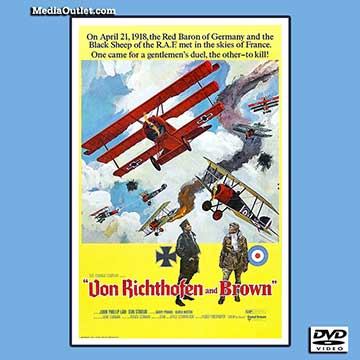
April 21, 1918: #DOTD: #RIP: Manfred von
Richthofen, famously known as the World War I German fighter ace
"The Red Baron" (b. May 2, 1892) #dies when he is shot
down and killed just after 11:00 AM over Vaux-sur-Somme while
flying over Morlancourt Ridge near the Somme River. There has been
considerable discussion and debate regarding aspects of his
career, especially the circumstances of his death. He had been
pursuing a Sopwith Camel at very low altitude, piloted by novice
Canadian pilot Lieutenant Wilfrid "Wop" May of No. 209
Squadron, Royal Air Force. May had just fired on the Red Baron's
cousin Lt. Wolfram von Richthofen. On seeing his cousin being
attacked, Manfred flew to his rescue and fired on May, causing him
to pull away and saving Wolfram's life. Richthofen pursued May
across the Somme. The Baron was spotted and briefly attacked by a
Camel piloted by May's school friend and flight commander,
Canadian Captain Arthur "Roy" Brown. Brown had to dive
steeply at very high speed to intervene, and then had to climb
steeply to avoid hitting the ground. Richthofen turned to avoid
this attack, and then resumed his pursuit of May. It was almost
certainly during this final stage in his pursuit of May that a
single .303 bullet hit Richthofen, damaging his heart and lungs so
severely that it must have caused a quick death. In the last
seconds of his life, he managed to retain sufficient control to
make a rough landing in a field on a hill near the Bray-Corbie
road, just north of the village of Vaux-sur-Somme, in a sector
controlled by the Australian Imperial Force (AIF). There were
several witnesses, including Gunner Ernest W. Twycross, Gunner
George Ridgway, and Sergeant Ted Smout of the Australian Medical
Corps. Each of these men later claimed to have been the first to
reach the triplane, and each reported various versions of
Richthofen's last words, generally including the word "kaputt".
No. 3 Squadron, Australian Flying Corps was the nearest Allied air
unit and assumed responsibility for the Baron's remains.
Controversy and contradictory hypotheses continue to surround the
identity of the person who fired the shot that actually killed
Richthofen. The RAF credited Brown with shooting down the Red
Baron, but it is now generally agreed that the bullet which hit
Richthofen was fired from the ground. Richthofen died following an
extremely serious and inevitably fatal chest wound from a single
bullet, penetrating from the right armpit and resurfacing next to
the left nipple. Brown's attack was from behind and above, and
from Richthofen's left. Even more conclusively, Richthofen could
not have continued his pursuit of May for as long as he did (up to
two minutes) had this wound come from Brown's guns. Brown himself
never spoke much about what happened that day, claiming, "There
is no point in me commenting, as the evidence is already out
there.". Many sources have suggested that Sergeant Cedric
Popkin was the person most likely to have killed Richthofen,
including a 1998 article by Geoffrey Miller, a physician and
historian of military medicine, and a 2002 British Channel 4
documentary. Popkin was an anti-aircraft (AA) machine gunner with
the Australian 24th Machine Gun Company, and he was using a
Vickers gun. He fired at Richthofen's aircraft on two occasions:
first as the Baron was heading straight at his position, and then
at long range from the right. Given the nature of Richthofen's
wounds, Popkin was in a position to fire the fatal shot when the
pilot passed him for a second time, on the right. Some confusion
has been caused by a letter that Popkin wrote in 1935 to an
Australian official historian. It stated Popkin's belief that he
had fired the fatal shot as Richthofen flew straight at his
position. In this respect, Popkin was incorrect; the bullet which
caused the Baron's death came from the side. A 2002 Discovery
Channel documentary suggests that Gunner W. J. "Snowy"
Evans, a Lewis machine gunner with the 53rd Battery, 14th Field
Artillery Brigade, Royal Australian Artillery is likely to have
killed von Richthofen. Miller and the Channel 4 documentary
dismiss this theory because of the angle from which Evans fired at
Richthofen. Other sources have suggested that Gunner Robert Buie
(also of the 53rd Battery) may have fired the fatal shot. There is
little support for this theory. In 2007, a municipality in Sydney
recognised Buie as the man who shot down Richthofen, placing a
plaque near his former home. Buie died in 1964 and has never been
officially recognised in any other way. No. 3 Squadron AFC's
commanding officer Major David Blake initially suggested that
Richthofen had been killed by the crew of one of his squadron's
R.E.8s, which had also fought members of Richthofen's unit that
afternoon. This claim was quickly discounted and withdrawn, if
only because of the time factor. Following an autopsy that he
witnessed, Blake became a strong proponent of the view that an AA
machine gunner had killed Richthofen. Richthofen was a highly
experienced and skilled fighter pilot who was fully aware of the
risk from ground fire. Further, he concurred with the rules of air
fighting created by his late mentor Boelcke, who specifically
advised pilots not to take unnecessary risks. In this context,
Richthofen's judgement during his last combat was clearly unsound
in several respects.[60] Several theories have been proposed to
account for his behaviour. In 1999, a German medical researcher,
Henning Allmers, published an article in the British medical
journal The Lancet, suggesting it was likely that brain damage
from the head wound Richthofen suffered in July 1917 (see above)
played a part in the Red Baron's death. This was supported by a
2004 paper by researchers at the University of Texas. Richthofen's
behaviour after his injury was noted as consistent with
brain-injured patients, and such an injury could account for his
perceived lack of judgement on his final flight: flying too low
over enemy territory and suffering target fixation. Richthofen may
have been suffering from cumulative combat stress, which made him
fail to observe some of his usual precautions. One of the leading
British air aces, Major Edward "Mick" Mannock, was
killed by ground fire on 26 July 1918 while crossing the lines at
low level, an action he had always cautioned his younger pilots
against. One of the most popular of the French air aces, Georges
Guynemer, went missing on 11 September 1917, probably while
attacking a two-seater without realizing several Fokkers were
escorting it. There is a suggestion that on the day of
Richthofen's death, the prevailing wind was about 40 km/h (25 mph)
easterly, rather than the usual 40 km/h (25 mph) westerly. This
meant that Richthofen, heading generally westward at an airspeed
of about 160 km/h (100 mph), was travelling over the ground at up
to 200 km/h (125 mph) rather than the more typical ground speed of
120 km/h (75 mph). This was considerably faster than normal and he
could easily have strayed over enemy lines without realizing it.
At the time of Richthofen's death, the front was in a highly fluid
state, following the initial success of the German offensive of
March-April 1918. This was part of Germany's last opportunity to
win the war. In the face of Allied air superiority, the German air
service was having difficulty acquiring vital reconnaissance
information, and could do little to prevent Allied squadrons from
completing effective reconnaissance and close support of their
armies. No. 3 Squadron AFC officers were pallbearers and other
ranks from the squadron acted as a guard of honour during the Red
Baron's funeral on 22 April 1918. In common with most Allied air
officers, Major Blake, who was responsible for Richthofen's body,
regarded the Red Baron with great respect, and he organised a full
military funeral, to be conducted by the personnel of No. 3
Squadron AFC. The body was buried in the cemetery at the village
of Bertangles, near Amiens, on 22 April 1918. Six of No. 3
Squadron's officers served as pallbearers, and a guard of honour
from the squadron's other ranks fired a salute. Allied squadrons
stationed nearby presented memorial wreaths, one of which was
inscribed with the words, "To Our Gallant and Worthy Foe".
A speculation that his opponents organised a flypast at his
funeral, giving rise to the missing man formation, is most
unlikely and totally unsupported by any contemporary evidence. In
the early 1920s the French authorities created a military cemetery
at Fricourt, in which a large number of German war dead, including
Richthofen, were reinterred. In 1925 von Richthofen's youngest
brother, Bolko, recovered the body from Fricourt and took it to
Germany. The family's intention was for it to be buried in the
Schweidnitz cemetery next to the graves of his father and his
brother Lothar von Richthofen, who had been killed in a post-war
air crash in 1922. The German Government requested that the body
should instead be interred at the Invalidenfriedhof Cemetery in
Berlin, where many German military heroes and past leaders were
buried, and the family agreed. Richthofen's body received a state
funeral. Later the Third Reich held a further grandiose memorial
ceremony at the site of the grave, erecting a massive new
tombstone with the single word: Richthofen. During the Cold War,
the Invalidenfriedhof was on the boundary of the Soviet zone in
Berlin, and the tombstone became damaged by bullets fired at
attempted escapees from East Germany. In 1975 the body was moved
to a Richthofen family grave plot at the Sudfriedhof in Wiesbaden.
Manfred Albrecht Freiherr von Richthofen (2 May 1892 - 21 April
1918), also known as the "Red Baron", was a fighter
pilot with the German Air Force during World War I. He is
considered the ace-of-aces of the war, being officially credited
with 80 air combat victories. Originally a cavalryman, Richthofen
transferred to the Air Service in 1915, becoming one of the first
members of fighter squadron Jagdstaffel 2 in 1916. He quickly
distinguished himself as a fighter pilot, and during 1917 became
leader of Jasta 11 and then the larger fighter wing unit
Jagdgeschwader 1, better known as "The Flying Circus" or
"Richthofen's Circus" because of the bright colours of
its aircraft, and perhaps also because of the way the unit was
transferred from one area of allied air activity to another -
moving like a travelling circus, and frequently setting up in
tents on improvised airfields. By 1918, Richthofen was regarded as
a national hero in Germany, and respected by his enemies. He
remains one of the most widely known fighter pilots of all time,
and has been the subject of many books, films and other media. On
Sale @ 15% Off Discount Till Midnight PT!
https://store.earthstation1.com/von-richthofen-and-brown-dvd-red-baron-wwi.html
Today's
EarthStation1.com 15% Off Commemorative Memorial Title: The
Dictators: The Rise Of Fascism DVD, Video Download, USB Drive
Today, April 21, 2026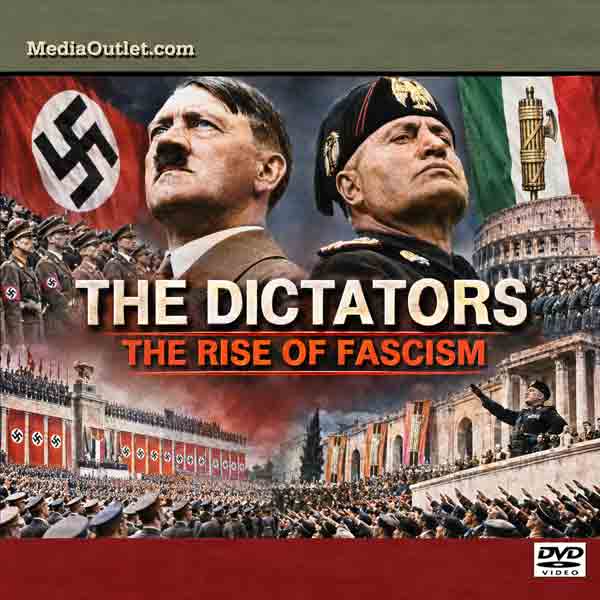
April 21, 1925: The Aftermath Of World
War I: Aftermath Of World War I In Italy: Revolutions Of
1917-1923: The Interwar Period (The Interbellum, Between The
Wars): Fascist Revolts: Riots And Civil Disorder In Italy: Fascist
And Anti-Fascist Violence In Italy (1919-1926): Italian Fascism:
The Manifesto Of The Fascist Intellectuals: -- The Roman newspaper
Il Mondo (January 26, 1922 - October 31, 1926), one of the last
independent newspapers to be suppressed by the Italian Fascist
Regime, publishes The Manifesto Of The Fascist Intellectuals,
written by the actualist idealist "philosopher" Giovanni
Gentile, establishing in literary form the political and
ideological foundations of Italian Fascism, and justifiing the
political violence of the Blackshirt paramilitaries of the
National Fascist Party (Partito Nazionale Fascista [PNF]) in the
revolutionary "realization" (terrorism really) of
Italian Fascism as the authoritarian and totalitarian regime of
Prime Minister Benito Mussolini, who ruled Italy as Il Duce ("The
Leader"), from 1922 to 1943. Actual Idealism was a twisted
form of idealism developed by Giovanni Gentile that grew into a
'grounded' idealism, contrasting the transcendental idealism of
Immanuel Kant, and the absolute idealism of G. W. F. Hegel. To
Gentile, who considered himself the "philosopher of Fascism,"
Actualism was the sole remedy to philosophically preserving free
agency, by making the act of thinking self-creative and,
therefore, without any contingency and not in the potency of any
other fact. The Manifesto of Fascist Intellectuals justifies the
political violence of the Blackshirt paramilitaries of the
National Fascist Party (PNF), in the revolutionary realisation of
Italian Fascism as the authoritarian and totalitarian regime of
Prime Minister Benito Mussolini, who ruled Italy as Il Duce ("The
Leader"), from 1922 to 1943. On Sale @ 15% Off Discount Till
Midnight PT!
https://store.earthstation1.com/the-dictators-the-rise-to-fascism-dvd-hitler-mussolini-wwii.html
Today's
EarthStation1.com 15% Off Commemorative Memorial Title: Elizabeth
R: A Year In The Life Of The Queen 1992 DVD, MP4, USB Drive
Today, April 21, 2026
April 21, 1926: #BOTD: #HBD! Elizabeth II
(Elizabeth Alexandra Mary Windsor), Queen of the United Kingdom
and the Commonwealth realms until her death (d. September 8, 2022)
is #born in Mayfair, London, England. She was queen regnant of 32
sovereign states during her lifetime and was head of state of 15
realms at the time of her death. Her reign of 70 years and 214
days was the longest of any British monarch and the longest
verified reign of any female head of state in history. Elizabeth
II was the first child of the Duke and Duchess of York, later King
George VI and Queen Elizabeth, and she was educated privately at
home. Her father acceded to the throne on the abdication of his
brother King Edward VIII in 1936, from which time she was the heir
presumptive. She began to undertake public duties during the
Second World War, serving in the Auxiliary Territorial Service. In
1947, she married Prince Philip, Duke of Edinburgh, a former
prince of Greece and Denmark, with whom she has four children:
Charles, Prince Of Wales; Anne, Princess Royal; Prince Andrew,
Duke of York; and Prince Edward, Earl of Wessex. When her father
died in February 1952, she became head of the Commonwealth and
queen regnant of seven independent Commonwealth countries: the
United Kingdom, Canada, Australia, New Zealand, South Africa,
Pakistan and Ceylon. She has reigned as a constitutional monarch
through major political changes, such as devolution in the United
Kingdom, Canadian patriation, and the decolonisation of Africa.
Between 1956 and 1992, the number of her realms varied as
territories gained independence and realms, including South
Africa, Pakistan, and Ceylon (renamed Sri Lanka), became
republics. Her many historic visits and meetings include a state
visit to the Republic Of Ireland and visits to or from five popes.
Significant events have included her coronation in 1953 and the
celebrations of her Silver, Golden, and Diamond Jubilees in 1977,
2002, and 2012 respectively. In 2017, she became the first British
monarch to reach a Sapphire Jubilee. She was the longest-lived and
longest-reigning British monarch as well as the world's
longest-reigning queen regnant and female head of state, and at
the time of her death was the oldest and longest-reigning current
monarch and the longest-serving current head of state. Elizabeth
had occasionally faced republican sentiments and press criticism
of the royal family, in particular after the breakdown of her
children's marriages, her "annus horribilis" ("horrible
year", an expression used by Queen Elizabeth II in her speech
at London's Guildhall on November 24, 1992 marking the 40th
anniversary of her accession) and the death in 1997 of her former
daughter-in-law Diana, Princess of Wales. However, support for the
monarchy has consistently been and remains high, as does her
personal popularity. Elizabeth II died peacefully at 15:10 BST at
Balmoral Castle, Aberdeenshire, Scotland at the age of 96, with
two of her children, Charles and Anne, by her side, the first
monarch to die in Scotland since James V in 1542; her death
certificate recorded her cause of death as "old age".
Her death was announced to the public at 18:30. She is buried at
St. George's Chapel, Windsor. Elizabeth's reign of 70 years and
214 days was the longest of any British monarch. She was succeeded
by her eldest son, Charles III. Elizabeth's death set in motion
the most recent version of Operation London Bridge, a funeral plan
first devised in the 1960s, and Operation Unicorn, the plan for
the Queen's death in Scotland. Elizabeth's coffin lay at rest in
St Giles' Cathedral in Edinburgh from 12 to 13 September, after
which it was flown to London, where it lay in state in Westminster
Hall from September 14 to 19. An estimated 33,000 people filed
past the Queen's coffin in Edinburgh, and approximately 250,000
people queued to pay their respects in London. The United Kingdom
observed a national mourning period of 10 days. Elizabeth's state
funeral on 19 September was the first held in Britain since
Winston Churchill's in 1965. A funeral service was held at
Westminster Abbey, followed by a procession to Wellington Arch
which featured around 3,000 military personnel and was watched by
approximately one million people in central London. The state
hearse then transported the Queen's coffin to Windsor, followed by
another procession through Windsor Great Park and a committal
service at St George's Chapel at Windsor Castle. The Queen was
interred later that evening with her husband, Prince Philip, in
the King George VI Memorial Chapel, in a private service attended
only by her closest family. Designated as a public holiday in the
UK and several Commonwealth states, the state funeral included
dignitaries from around the world and featured the largest
security operation ever mounted in the UK. Coverage of the state
funeral was one of the UK's most watched special television
broadcasts, surpassing the wedding of Prince William and Catherine
Middleton, the previous most-watched royal event of the 21st
century. The period of official mourning and the funeral was
estimated to have cost the government 162M PS. On Sale @ 15% Off
Discount Till Midnight PT!
https://store.earthstation1.com/elizabeth-r-a-year-in-the-life-of-the-queen-1992-dvd-mp19924.html
Today's
EarthStation1.com 15% Off Commemorative Memorial Title: Monsters!
Mysteries Or Myths? + Bonus Yeti Doc MP4 Video Download DVD
Today, April 21, 2026
April 21, 1934: Biology: Zoology:
Cryptozoology: The Loch Ness Monster (Nessie): Hoaxes: The
Surgeon's Photograph: -- The most famous photo allegedly showing
the Loch Ness Monster, is published in the Daily Mail; in 1999, it
was revealed to be a hoax. Supposedly taken by Robert Kenneth
Wilson, a London gynaecologist, the photograph, which became known
as "The Surgeon's Photograph", was supposed to be the
first published photo of the creature's head and neck. Wilson's
refusal to have his name associated with it led to it being known
as the "surgeon's photograph". According to Wilson, he
was looking at the loch when he saw the monster, grabbed his
camera and snapped four photos. Only two exposures came out
clearly; the first reportedly shows a small head and back, and the
second shows a similar head in a diving position. The first photo
became well known, and the second attracted little publicity
because of its blurriness. For 60 years the photo was considered
evidence of the monster's existence, although sceptics dismissed
it as driftwood, an elephant, an otter or a bird. The photo's
scale was controversial; it is often shown cropped (making the
creature seem large and the ripples like waves), while the
uncropped shot shows the other end of the loch and the monster in
the centre. The ripples in the photo were found to fit the size
and pattern of small ripples, rather than large waves photographed
up close. Analysis of the original image fostered further doubt.
In 1993, the makers of the Discovery Communications documentary
Loch Ness Discovered analysed the uncropped image and found a
white object visible in every version of the photo (implying that
it was on the negative). It was believed to be the cause of the
ripples, as if the object was being towed, although the
possibility of a blemish on the negative could not be ruled out.
An analysis of the full photograph indicated that the object was
small, about 60 to 90 cm (2 to 3 ft) long. Since 1994, most
experts agreed that the photo was an elaborate hoax. It had been
described as fake in a December 7, 1975 Sunday Telegraph article
that fell into obscurity. Details of how the photo was taken were
published in the 1999 book, Nessie - the Surgeon's Photograph
Exposed, which contains a facsimile of the 1975 Sunday Telegraph
article. The creature was reportedly a toy submarine built by
Christian Spurling, the son-in-law of Marmaduke Wetherell.
Wetherell had been publicly ridiculed by his employer, the Daily
Mail, after he found "Nessie footprints" that turned out
to be a hoax. To get revenge on the Mail, Wetherell perpetrated
his hoax with co-conspirators Spurling (sculpture specialist), Ian
Wetherell (his son, who bought the material for the fake), and
Maurice Chambers (an insurance agent).[45] The toy submarine was
bought from F. W. Woolworths, and its head and neck were made from
wood putty. After testing it in a local pond the group went to
Loch Ness, where Ian Wetherell took the photos near the Altsaigh
Tea House. When they heard a water bailiff approaching, Duke
Wetherell sank the model with his foot and it is "presumably
still somewhere in Loch Ness". Chambers gave the photographic
plates to Wilson, a friend of his who enjoyed "a good
practical joke". Wilson brought the plates to Ogston's, an
Inverness chemist, and gave them to George Morrison for
development. He sold the first photo to the Daily Mail, who then
announced that the monster had been photographed. On Sale @ 15%
Off Discount Till Midnight PT!
https://store.earthstation1.com/monsters-mysteries-or-myths-dvd-loch-ness-monster-yeti-bigfoot.html
Today's
EarthStation1.com 15% Off Commemorative Memorial Title: Andy
Warhol (1987) Documentary Mel Melvyn Bragg MP4 Video Download DVD
Today, April 21, 2026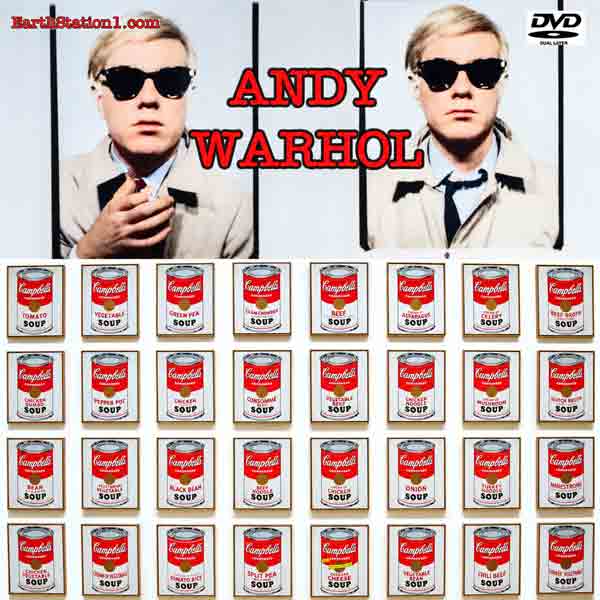
April 21, 1943: #BOTD: #HBD! Edie Sedgwick, American actress, fashion model and beauty, known for being one of Andy Warhol's superstars, known as "The Girl of the Year" in 1965 after starring in several of Warhol's short films in the 1960s, dubbed an "It Girl", and named by Vogue magazine a "Youthquaker", likely inspiration of Bob Dylan's song "Like A Rolling Stone" as well as other of his songs (d. November 16, 1971) is #born Edith Minturn Sedgwick in Santa Barbara, California, the seventh of eight children of Alice Delano de Forest (1908-1988) and Francis Minturn Sedgwick (1904-1967), a rancher and sculptor. Edith Minturn Sedgwick Post is a member of the historical Sedgwick family of Massachusetts, and is the first cousin once removed of fellow actress and beauty Kyra Sedgwick. Sedgwick relationship with Andy Warhol deteriorated by late 1965, and Sedgwick demanded that Warhol stop showing her films. After breaking with Andy Warhol and the inner circle of his studio The Factory, Sedgwick began living at the Chelsea Hotel, where she became close to Bob Dylan. Dylan and his friends eventually convinced Sedgwick to sign up with Albert Grossman, Dylan's manager. According to Paul Morrissey, Sedgwick had developed a crush on Dylan that she thought he reciprocated. She was also under the impression that she and Dylan would star in a mainstream film together. Unbeknownst to Sedgwick, Dylan had secretly married his girlfriend Sara Lownds in November 1965. Morrissey claimed that Sedgwick was informed of the marriage by Warhol (who reportedly heard about it through his lawyer) in February 1966. Friends of Sedgwick's later said that she saw the supposed offer of doing a film with Dylan as a ticket to a mainstream film career. Paul Morrissey claimed that Dylan likely never had plans to star in a film with Sedgwick, and Dylan "hadn't been very truthful." Since Sedgwick's death, Bob Dylan has routinely denied that he ever had a romantic relationship with her, but did acknowledge knowing her. In December 2006, several weeks before the release of the controversial film 2006 Factory Girl about Sedgwick's rapid rise and fall, the Weinstein Company and the film's producers interviewed Sedgwick's older brother, Jonathan, who said that Sedgwick told him she had aborted a baby she claimed was Dylan's. Jonathan Sedgwick claimed that Edie had the abortion soon after she was injured in a motorcycle accident. As a result of the accident, doctors consigned her to a mental hospital where she was treated for drug addiction. Despite this account, no hospital records or Sedgwick family records exist to support this story. Nonetheless, Sedgwick's brother also claimed "Staff found she was pregnant but, fearing the baby had been damaged by her drug use and anorexia, forced her to have the abortion." The Bob Dylan song "Like a Rolling Stone" is reportly inspired by her; his songs "Just Like a Woman", "Leopard-Skin Pill-Box Hat" and "Fourth Time Around" from his 1966 album Blonde On Blonde are also reportedly about her. The Velvet Underground's "Femme Fatale" from their 1967 album The Velvet Underground & Nico was certainly written about her. Though her mental health deteriorated from her drug abuse, she continued to struggle to complete the semi-autobiographical film Ciao! Manhattan, completing filming in early 1971. The film was released postumously in July 1972. Edie Sedgwick died in Santa Barbara, California, aged 28, of what the coroner ruled as "undetermined/accident/suicide". Her death certificate states the immediate cause was "probable acute barbiturate intoxication" due to ethanol intoxication. Sedgwick's alcohol level was registered at 0.17%, and her barbiturate level was 0.48 mg%. In the summer of 1970, Sedgwick had met Michael Post, who was a fellow patient at the psychiatric ward of the Santa Barbara Cottage Hospital, at which both were hospitalized for drug abuse treatment. They married on July 24, 1971. During this time she gave up drugs and alcohol, but four months later in October 1971, she relapsed after taking prescription pain medication given to her for a physical illness, which in turn led to abusing barbiturates and alcohol. Edie Sedgwick was not buried in her family's Sedgwick Pie cemetery plot but in the small Oak Hill Cemetery in Ballard, California. Her epitaph reads "Edith Sedgwick Post - Wife Of Michael Brett Post 1943-1971". On Sale @ 15% Off Discount Till Midnight PT! https://store.earthstation1.com/anwa1domelme.html
Today's
EarthStation1.com 15% Off Commemorative Memorial Title: Rock &
Roll An Unruly History 10 Part TV Series MP4 Video Download DVD
Today, April 21, 2026
April 21, 1947: #BOTD: #HBD! Iggy Pop,
American singer, songwriter, musician, record producer, and actor
designated the "Godfather Of Punk", vocalist and
lyricist of influential proto-punk band the Stooges, who were
formed in 1967 and have disbanded and reunited multiple times
since, is #born James Newell Osterberg Jr. in Muskegon, Michigan.
Initially playing a raw, primitive style of rock and roll, the
band sold few records in their original incarnation and gained a
reputation for their confrontational performances, which often
involved acts of self-mutilation by Pop. He had a long
collaborative and personal friendship with David Bowie over the
course of his career, beginning with the Stooges' album Raw Power
in 1973. With both musicians having relocated to West Berlin to
wean themselves off their respective drug addictions, Pop began
his solo career by collaborating with Bowie on the 1977 albums The
Idiot and Lust for Life with Pop usually contributing the lyrics.
Throughout his career, Pop is well known for his outrageous and
unpredictable stage antics, poetic lyrics and distinctive voice.
He was one of the first performers to do a stage-dive and
popularized the activity. Pop, who traditionally (but not
exclusively) performs bare-chested, also performed such stage
theatrics as rolling around in broken glass and exposing himself
to the crowd. Pop's music has encompassed a number of styles over
the course of his career, including garage rock, punk rock, hard
rock, heavy metal, art rock, new wave, jazz, blues, and
electronic. Though his popularity has fluctuated through the
years, many of Pop's songs have become well known, including
"Search and Destroy" and "I Wanna Be Your Dog"
by the Stooges, and his solo hits "Lust for Life", "The
Passenger" and "Real Wild Child (Wild One)". In
1990, he recorded his first and only Top 40 U.S. hit, "Candy",
a duet with B-52's singer Kate Pierson. Pop's song China Girl
became more widely known when it was re-recorded by co-writer
Bowie, who released it as the second single from his most
commercially successful album, Let's Dance (1983). The UK single
release of Bowie's version reached No. 2 for one week on 14 June
1983, while the US release reached No. 10. Bowie re-recorded and
performed many of Iggy's songs throughout his career. Although Pop
has had limited commercial success, he has remained both a culture
icon and a significant influence on a wide range of musicians in
numerous genres. The Stooges' album Raw Power has proved an
influence on artists such as Sex Pistols, the Smiths, the Sisters
of Mercy, Red Hot Chili Peppers, and Nirvana. His solo album The
Idiot has been cited as a major influence on a number of
post-punk, electronic and industrial artists including Depeche
Mode, Nine Inch Nails and Joy Division, and was described by
Siouxsie Sioux as a "re-affirmation that our suspicions were
true: the man is a genius." He was inducted as part of the
Stooges into the Rock and Roll Hall of Fame in 2010. On Sale @ 15%
Off Discount Till Midnight PT!
https://store.earthstation1.com/rock-amp-roll-an-unruly-history-10-part-tv-series-mp4-video-download-104.html
Today's
EarthStation1.com 15% Off Commemorative Memorial Title: The
Emperor's Eye: Taiwan's National Palace Art Museum DVD, MP4, USB
Today, April 21, 2026
April 21, 1949: China: The History Of
China: The Century Of Humiliation (The Hundred Years Of National
Humiliation) (1838-1945): The Chinese Civil War: The History Of
The Republic Of China (1912-1949): The Yangtze River Crossing
Campaign (Chinese: Du Jiang Zhanyi): -- The end of Kuomintang rule
in China (KMT, also known as Guomintang [GMD]) is marked in the
final stage of the Chinese Civil War as Nanjing, the capital of
the KMT's Nationalist government, whose defense was led by Tang
Enbo and Bai Chongxiin, is captured by The People's Liberation
Army (PLA) of the Chinese Communist Party (CCP), under the joint
command of Liu Bocheng, Chen Yi and future leader of China Deng
Xiaoping. The Fall Of Nanjing forced the GMD government to
retreat, who took with them as many cultural artifacts as they
could carry, suggesting that the war was over; when the city
center of Shanghai fell to the Communists on May 27, and the rest
of the Zhejiang fell to the communist Chinese on June 2, it marked
both the end of the Yangtze River Crossing Campaign and the end of
Chinese Civil War. On Sale @ 15% Off Discount Till Midnight PT!
https://store.earthstation1.com/the-emperors-eye-dvd-world39s-greatest-chinese-art-collecti39.html
Today's
EarthStation1.com 15% Off Commemorative Memorial Title: The 1964
New York World's Fair Films Set DVD, Download, USB Drive
Today, April 21, 2026
April 21, 1965: Grand Openings: World's
Fair Openings: -- The 1964-1965 New York World's Fair opens for
its second and final season. The 1964/1965 New York World's Fair
held over 140 pavilions, 110 restaurants, for 80 nations (hosted
by 37), 24 US states, and over 45 corporations to build exhibits
or attractions at Flushing Meadows Park in Queens, NY. The immense
fair covered 646 acres (261 ha) on half the park, with numerous
pools or fountains, and an amusement park with rides near the
lake. However, the fair did not receive official sanctioning from
the Bureau of International Expositions (BIE) due to a
heavily-publicized rules dispute between fair organizier Robert
Moses and the BIE over time length, state fair frequency and fees.
Hailing itself as a "universal and international"
exposition, the fair's theme was "Peace Through
Understanding", dedicated to "Man's Achievement on a
Shrinking Globe in an Expanding Universe". American companies
dominated the exposition as exhibitors. The theme was symbolized
by a 12-story-high, stainless-steel model of the earth called the
Unisphere, built on the foundation of the Perisphere from the 1939
NYC fair. The fair ran for two six-month seasons, April 22 -
October 18, 1964, and April 21 - October 17, 1965. Admission price
for adults (13 and older) was $2 in 1964 (equivalent to $15.78 in
2017) but $2.50 (equivalent to $19.41 in 2017) in 1965, and $1 for
children (2-12) both years (equivalent to $7.89 in 2017). The fair
is noted as a showcase of mid-20th-century American culture and
technology. The nascent Space Age, with its vista of promise, was
well represented. More than 51 million people attended the fair,
though fewer than the hoped-for 70 million. It remains a
touchstone for many American Baby Boomers, who visited the
optimistic fair as children before the turbulent years of the
Vietnam War, cultural changes, and increasing domestic violence
associated with the Civil Rights Movement. In many ways the fair
symbolized a grand consumer show covering many products produced
in America at the time for transportation, living, and consumer
electronic needs in a way that would never be repeated at future
world's fairs in North America. Many major American manufacturing
companies from pen manufacturers, to chemical companies, to
computers, to automobiles had a major presence. This fair gave
many attendees their first interaction with computer equipment.
Corporations demonstrated the use of mainframe computers, computer
terminals with keyboards and CRT displays, teletype machines,
punch cards, and telephone modems in an era when computer
equipment was kept in back offices away from the public, decades
before the Internet and home computers were at everyone's
disposal. On Sale @ 15% Off Discount Till Midnight PT!
https://store.earthstation1.com/the-1964-new-york-world39s-fair-fil196439.html
Today's
EarthStation1.com 15% Off Commemorative Memorial Title: Z (1969)
Grigoris Lambrakis & The Greek Generals Coup Of 1967 MP4 DVD
Today, April 21, 2026
April 21, 1967: Greece: Modern Greece
(The Hellenic Republic): Politics Of Greece: Elections In Greece:
The 1967 Greek Legislative Election: The Greek Junta (The Regime
Of The Colonels, The Greek Military Junta Of 1967-1974, The Junta,
The Dictatorship, The Seven Years): The Coup D'Etat Of April 21):
-- The Coup D'Etat Of April 21: -- A few days before the general
election in Greece, Colonel George Papadopoulos leads a coup
d'etat, establishing a military regime that lasts for seven years.
The Greek Military Junta Of 1967-1974, commonly known as the
Regime of the Colonels, or in Greece simply The Junta, The
Dictatorship and The Seven Years, was a series of far-right
military juntas that ruled Greece following the 1967 Greek coup
d'etat led by a group of colonels on 21 April 1967. The
dictatorship ended on 24 July 1974 under the pressure of the
Turkish invasion of Cyprus. The fall of the junta was followed by
the Metapolitefsi (the transitional period from the fall of the
dictatorship to the 1974 legislative elections and the democratic
period immediately after these elections) and the establishment of
the Third Hellenic Republic (formed after both the fall of Greek
military junta and final the abolition of the Greek monarchy),
which rules up to the present day. On Sale @ 15% Off Discount Till
Midnight PT!
https://store.earthstation1.com/z-1969-dvd-yves-montand-irene-papas-jeanlouis-trintig1969.html
Today's
EarthStation1.com 15% Off Commemorative Memorial Title: Radio
First Termer: Dave Rabbit Vietnam Radio CD, MP3 Download, USB
Today, April 21, 2026
April 21, 1975: The Aftermath Of World
War II: The Cold War: The Cold War In Asia: The Indochina Wars:
The Vietnam War (The Second Indochina War, The Vietnam Conflict,
The Resistance War Against America): The 1975 Spring Offensive
{Vietnamese: Chien Dich Mua Xuan 1975; officially The General
Offensive And Uprising Of Spring 1975 (Vietnamese: Tong Tien Cong
Va Noi Day Mua Xuan 1975)}: The Battle Of Xuan Loc (Vietnamese:
Tran Xuan Loc) (The Fall Of Saigaon, The Fall Of South Vietnam):
-- President of South Vietnam Nguyen Van Thieu flees Saigon, as
Xuan Loc, the last South Vietnamese outpost blocking a direct
North Vietnamese assault on Saigon, falls. The cover of the
EarthStation1.com "Radio First Termer" MP3 CD is a photo
of Thieu' helicopter take him out of Saigon. In January 1995 J. C.
Kaelin digitized .wav sound files of this broadcast and posted
them to Usenet .wav newsgroups shortly thereafter, and when he
founded EarthStation1.com on March 26, 1996, it opened with a
collection of those sound files. In February 2006, the anonymous
"Dave Rabbit" who made these broadcasts revealed himself
in an email to J. C. as Dave DeLay. Dave died in 2012. The Battle
of Xuan Loc (April 9-21, 1975) was the last major battle of the
Vietnam War. It took place at Xuan Loc, Dong Nai Province over a
period of twelve days as outnumbered South Vietnamese reserves
attempted to stop the North Vietnamese forces from overrunning the
town and breaking through towards South Vietnam's capital, Saigon.
The Army of the Republic of Vietnam (ARVN) committed almost all
their remaining mobile forces, especially the 18th Division, under
Brigadier General Le Minh Dao, to the defence of the strategic
crossroads town of Xuan Loc, hoping to stall the People's Army of
Vietnam (PAVN) advance. The battle ended when the town of Xuan Loc
was captured by the PAVN 4th Army Corps led by Major General Hoang
Cam. From the beginning of 1975, PAVN forces swept through the
northern provinces of South Vietnam virtually unopposed. In the
Central Highlands, the ARVN II Corps was completely destroyed,
whilst attempting to evacuate to the Mekong Delta region. In the
cities of Hue and Da Nang, ARVN units simply dissolved without
putting up resistance. The devastating defeats suffered by the
ARVN prompted South Vietnam's National Assembly to question
President Nguyen Van Thieu's handling of the war, thereby placing
him under tremendous pressure to resign. The ARVN III Corps' last
defensive line east of Saigon connected the city of Binh Duong,
Bien Hoa Air Base, Vung Tau, Long An and the lynchpin centered on
the strategic town of Xuan Loc, where the South Vietnamese Joint
General Staff committed the nation's final reserve forces in
Saigon's defense. In the last-ditch effort to save South Vietnam,
Thieu ordered the 18th Infantry Division to hold Xuan Loc at all
costs. The PAVN, on the other hand, was ordered to capture Xuan
Loc in order to open the gateway to Saigon. During the initial
stages of the battle, the 18th Division managed to beat off early
attempts by the PAVN to capture the town, forcing PAVN commanders
to change their battle plan. However, on 19 April 1975, Dao's
forces were ordered to withdraw after Xuan Loc was almost
completely isolated, with all remaining units badly mauled. This
defeat also marked the end of Thieu's political career, as he
resigned on 21 April 1975. Once Xuan Loc fell, the PAVN battled
with the last remaining elements of III Corps Armored Task Force,
remnants of the 18th Infantry Division and depleted Marine,
Airborne and Ranger Battalions in a fighting retreat that lasted
nine days, until they reached Saigon and PAVN armored columns
crashed through the gates of South Vietnam's Presidential Palace
on 30 April 1975, effectively ending the war. On Sale @ 15% Off
Discount Till Midnight PT!
https://store.earthstation1.com/radio-first-termer-mp3-cd-dave-rabbit-vietnam-war-broadcast3.html
Today's
EarthStation1.com 15% Off Commemorative Memorial Title: The 1989
Tiananmen Square Protests DVD, MP4 Download, USB Flash Drive
Today, April 21, 2026
April 21, 1989: The Aftermath Of World
War II: The Cold War: Democracy Movements Of China : The
Revolutions Of 1989 (The Fall Of Nations, The Autumn Of Nations,
The Fall Of Communism): The 1989 Tiananmen Square Protests And
Massacre (The June Fourth Incident, The Tiananmen Square
Massacre., The '89 Democracy Movement, The Tiananmen Square
Incident, The Tiananmen Uprising): -- In Beijing, around 100,000
students gather in Tiananmen Square to commemorate Chinese reform
leader Hu Yaobang, who had died six days prior. Hu Yaobang
(November 20, 1915 - April 15, 1989) was a high-ranking official
of the People's Republic Of China who held the top office of the
Communist Party of China from 1981 to 1987, first as Chairman from
1981 to 1982, then as General Secretary from 1982 to 1987. Hu
joined the Chinese Communist Party in the 1930s, and rose to
prominence as a comrade of Deng Xiaoping in the 1970s. During the
Cultural Revolution (1966-1976), Hu was purged, recalled, and
purged again by Mao Zedong. After Deng rose to power, following
the death of Mao Zedong, Hu was promoted to a series of high
political positions. Throughout the 1980s Hu pursued a series of
economic and political reforms under the direction of Deng. Hu's
political and economic reforms made him the enemy of several
powerful Party elders, who opposed free market reforms and
attempts to make China's government more transparent. When
widespread student protests occurred across China in 1987, Hu's
political opponents successfully blamed Hu for the disruptions,
claiming that Hu's "laxness" and "bourgeois
liberalization" had either led to, or worsened, the protests.
Hu was forced to resign as Party general secretary in 1987, but
was allowed to retain a seat in the Politburo. Hu's position as
Party general secretary was taken by Zhao Ziyang, who continued
many of Hu's economic and political reforms. A day after Hu's
death, small-scale demonstrations commemorated him in Xi'an and
Shanghai and demanded that the government reassess his legacy. On
17 April, students at the China University of Political Science
and Law (CUPL) made a large wreath to commemorate Hu. Its
laying-party was on 17 April and a larger-than-expected crowd
assembled. At 5 pm, 500 CUPL students reached the eastern gate of
the Great Hall of the People, near Tiananmen Square, to mourn Hu.
The gathering featured speakers from various backgrounds giving
public orations commemorating Hu and discussing social problems.
However, it was soon deemed obstructive to the operation of the
Great Hall, so police tried to persuade the students to disperse.
Beginning on the night of 17 April, three thousand Peking
University students marched from the campus towards Tiananmen
Square, and soon nearly a thousand students from Tsinghua
University joined. Upon arrival, they soon joined forces with
those already gathered at the Square. As its size grew, the
gathering gradually evolved into a protest, as students began to
draft a list of pleas and suggestions (Seven Demands) for the
government: 1) Affirm Hu Yaobang's views on democracy and freedom
as correct; 2) Admit that the campaigns against spiritual
pollution and bourgeois liberalization had been wrong; 3) Publish
information on the income of state leaders and their family
members; 4) Allow privately run newspapers and stop press
censorship; 5) Increase funding for education and raise
intellectuals' pay; 6) End restrictions on demonstrations in
Beijing; and 7) Provide objective coverage of students in official
media. On the morning of 18 April, students remained in the
Square. Some gathered around the Monument to the People's Heroes
singing patriotic songs and listening to impromptu speeches by
student organizers, others gathered at the Great Hall. Meanwhile,
a few thousand students gathered at Xinhua Gate, the entrance to
Zhongnanhai, the seat of the party leadership, where they demanded
dialogue with the leadership. Police restrained the students from
entering the compound. Students then staged a sit-in. On 20 April,
most students had been persuaded to leave Xinhua Gate. To disperse
about 200 students that remained, police used batons; minor
clashes were reported. Many students felt abused by the police,
and rumours about police brutality spread quickly. This incident
angered students on campus, where those who were not politically
active decided to join the protests. Also on this date, a group of
workers calling themselves the Beijing Workers' Autonomous
Federation issued two handbills challenging the central
leadership. Hu's state funeral took place on 22 April. On the
evening of 21 April, some 100,000 students marched on Tiananmen
Square, ignoring orders from Beijing municipal authorities that
the Square was to be closed off for the funeral. The funeral,
which took place inside the Great Hall and attended by the
leadership, was broadcast live to the students. General secretary
Zhao Ziyang delivered the eulogy. The funeral seemed rushed, and
only lasted 40 minutes, as emotions ran high in the Square.
Students wept. Following the government's violent suppression in
May of Tiananmen Square Protests Of 1989, the Chinese government
censored the details of Hu's life within mainland China, but it
officially rehabilitated his image and lifted its censorship
restrictions on the 90th anniversary of Hu's birth, in 2005. On
Sale @ 15% Off Discount Till Midnight PT!
https://store.earthstation1.com/the-1989-tiananmen-square-protests-dvd-mp4-usb-19894.html
Today's
EarthStation1.com 15% Off Commemorative Memorial Title: Making
Sense Of The Sixties TV Series DVD, Video Download, USB Drive
Today, April 21, 2026
April 21, 2022: Drugs: Recreational
Drugs: Psychoactive Drugs: Cannabis (Pot, Marijuana, Marihuana,
Mary Jane, Weed, Reefer): -- Marijuana becomes legal to sell or
purchase for recreational use in New Jersey. Cannabis in New
Jersey is thereafter legal for both medical use and recreational
use. An amendment legalizing cannabis became part of the state
constitution on January 1, 2021, and enabling legislation and
related bills were signed into law by governor Phil Murphy on
February 22, 2021. Efforts at legalization through a New Jersey
Legislature bill during the 2018-2019 legislative session were
unsuccessful, but in December 2019, the Legislature placed a
referendum on legalization on the 2020 ballot. On November 3,
2020, Question 1 passed with 67% approval. On December 17 the New
Jersey legislature approved a bill setting up a recreational
marketplace. Disagreements between the governor and legislature
over the lack of underage penalties in the legislation
decriminalizing cannabis led to the effective date of cannabis
legalization being delayed from January 1 until February 22, and
police continued to arrest residents for marijuana offenses
regularly during that time period. On Sale @ 15% Off Discount Till
Midnight PT!
https://store.earthstation1.com/making-sense-of-the-sixties-tv-documentary-series-6-hour-episode6.html
Today's
EarthStation1.com #OnThisDay Commemorative Memorial Title:
Challenge Of The Yukon Old Time Radio Series MP3 Set DVD Download
USB
Today, April 21, 2026 April 21: National Bulldogs Are Beautiful
Day: -- Bulldogs, beautiful? Well, yes! French, American, or
English - bulldogs portray glamour in their own special way. It's
true that people (as a rule) can't get away with a lot of
slobbering and wrinkles, but bulldogs make it an art form. They
started popping up as furry companions in historical literature
about five centuries ago. Today this sweet sidekick continually
ranks as one of the most popular dog breeds in the U.S. French
bulldogs currently sit fourth on the American Kennel Club's list.
(Bulldogs, technically a separate breed, are fifth.) Just like the
pit bull, bulldogs were bred originally to assist butchers in
controlling livestock. The history of bulldogs predates that of
pit bulls, however, tracing back to 5th century England, to a
breed called the Alaunt. In the 15th century, other than catching
cattle and horses on farms, bulldogs were used in the barbaric
activity of bull-baiting; in which dogs were pitted against bulls
to fight until the bull was pulled to the ground or the dog was
killed by the bull. Thankfully, bull-baiting was banned in 1835.
Until this time, bulldogs were bred to be aggressive and a dog
weighing 80 pounds could easily toss a bull weighing a ton down by
corkscrewing its own body around its neck. After bull-baiting
ended in the U.K, it seemed that there would be no further use for
bulldogs and that the breed would eventually become extinct.
Luckily, the exportation of the breed to Germany and the U.S.
expanded the line of work in which bulldogs were used. They
continued herding cattle and hogs, especially in parts of the
country where terrains were too rough for building fences.
Bulldogs were crossbred in Germany to create the boxer breed. The
aggressive bulldog was downsized in England, although it is
uncertain whether this was accomplished by selective breeding of
smaller dogs or cross-breeding with pugs. The modern bulldog is
gentle, affectionate, and stable both in terms of temperament and
appearance. They may be small but are capable of great power and
are super-loyal and brave when it comes to their human companions,
especially children.
https://store.earthstation1.com/challenge-of-the-yukon-mp3-dvd-complete-radio-broadcast3.html
Today's
EarthStation1.com #OnThisDay Commemorative Memorial Title: An Old
Time Radio Christmas MP3 Set DVD, Audio Download, USB Stick
Today, April 21, 2026April 21: National Kindergarten Day: --
Get out your crayons and flash cards! Today, the birthday of
Johann Friedrich Oberlin, who in 1779 teamed up with Louis
Scheppler got together to create the first kindergarten in
Strasbourg, France, as well as the birthday of Friedrich Frobel,
the German educator who founded the first play and activity
institute called kindergarten in 1837. This is a time when we
celebrate that magical time during childhood where we started
spending our days away from our parent's homes. Kindergarten is a
mid-19th century German word literally meaning "children's
garden". According to Froebel, young children should follow
their own interests and freely explore them. That's why
kindergartens include singing, dancing, and creative play. We need
to find our nap mat just thinking about it! This is a day when
enter a world of other children guided under the hand of an adult
and start on the amazing journey that is learning. We start
learning our ABC's, colors, and shapes, and generally how to be a
functioning human being in a society of other human beings. In
1779, it became apparent to a young Johann Friedrich Oberlin that
there were many children in his Strasbourg community that were
left alone during the day while their parents were away dealing
with their other responsibilities. He and Louis Scheppler got
together to create the first kindergarten, a school aimed at
taking these children and teaching them during these hours. This
set a precedent that was soon emulated the world over, first in
1780 in Bavaria, and then in Detmoid in 1802 by Princess Pauline
zur Lippe. In 1816 Robert Owen founded the first one in New
Lanark, Scotland, and then in 1819 Samuel Wilderspin pushed the
idea in earnest, creating one in London, and then hundreds more to
follow. Almost all of us attended kindergarten, a magical time of
learning, snack-time, and play with new friends that has stood the
test of time and proven to be an incredibly important part of our
formative years. Kindergarten helps children to express and
explore their creativity. It also teaches children to ask
questions and learn the answers to the things they don't know.
Curiosity is so important, and kindergarten teaches children that
questions can be answered. It also helps to foster independence by
having children learn to be responsible for their own possessions
and to help clean up messes, turn in work, and learn basic life
skills. National Kindergarten Day tells us to remember these days
and the incredible people who started it all over 200 years ago!
https://store.earthstation1.com/christmas-radio-mp3-dvd-old-time-broadcast-antholog3.html
Today's
EarthStation1.com #OnThisDay Commemorative Memorial Title: Reefer
Madness (1936) Anti-Drug Propaganda Film DVD, MP4, USB Drive
Today, April 21, 2026April 21: National Surprise Drug Test
Day: -- A Counter-Counter Culture day deliberatedly observed the
day AFTER 420 Day (National Marijuana Day or National Weed Day) by
annoyed authority figures in both offices and homes. This has led
to debates about the ethics of conducting surprise, mandatory drug
tests for employees. Employees who test positive for the substance
might be at risk of losing their jobs, while children who test
positive would almost certainly be punished, else they wouldn't be
tested in the first place. This has become the subject of heated
debates and advocacy groups for the legalization of marijuana
argue against the unfairness of letting go of employees merely on
the basis that they are marijuana users. This is especially so in
states where marijuana use is legal. According to the outreach
director of the National Organization for the Reform of Marijuana
Laws (NORML,) a legal advocacy group: "Even though marijuana
is legal and readily available in several states, consumers are
being unfairly forced to choose between their job and smoking off
the clock because of obsolete employment practices." On the
other side of the debate, legitimate reasons exist for the policy
of surprise drug testing, such as the fact that workers in certain
industries must never be under the influence of drugs while on the
job because of the negative consequences that might occur. For
instance, transportation workers who require total concentration,
doctors and nurses who need to be clear-minded and focused.
National Surprise Drug Test Day is a good avenue for discussion
between both sides and an opportunity to provide information about
drug use and abuse.
https://store.earthstation1.com/reefer-madness-dvd-1936-antidrug-1936.html
Today's
EarthStation1.com #OnThisDay Commemorative Memorial Title: In The
Suburbs: Life In Suburbia Films DVD, Video Download, USB Drive
Today, April 21, 2026April 21: Keep Off the Grass Day: --
Created by a woman named Jace Shoemaker-Galloway, this holiday has
been observed since 2013. "Keep off the grass" signs
have often been used by people to prevent their lawns from being
trampled on and to prevent trespassing. Grass has been maintained
and used for decorative and protective purposes since the Middle
Ages, especially in Europe where they featured around castles and
wealthy homes. Today, many homes in America maintain lush lawns
for decorative purposes. Keep Off the Grass Day took place for the
first time in 2013. The holiday was invented by Jace
Shoemaker-Galloway, a freelance writer who specializes in creating
unusual holidays. As for the phrase "Keep off the grass,"
it is often written on signs placed on lawns to keep people from
trampling on the grass. The word 'lawn' is derived from the Middle
English 'launde,' which refers to an open glade in the woods.
Later, the word came to include artificial stretches of land,
which bore similarities to glades. During Medieval times, lawns
were usually found around castles in Britain and France. They were
usually devoid of trees so guards could have an unobstructed view
of the surroundings and be adequately warned of any attacks or
threats. Alternatively, lawns also referred to the village commons
for sheep and cattle grazing. In the 16th century, during the
Renaissance era, wealthy homes often maintained lawns, especially
in Britain and France. However, instead of planting grass, herbs
such as chamomile and thyme were planted. In the 17th century,
closely shorn grass lawns became a fixture in the homes of the
wealthy and were seen as a status symbol. At the time, lawnmowers
and other machinery hadn't been invented yet so the work of
trimming grass fell to laborers or servants. Only prosperous
landowners could afford the expense of hiring laborers, which is
why lawns became symbols of wealth in England. In the 19th
century, lawnmowers came onto the scene. In 1830, Edwin Beard
Budding invented the first lawnmower in Brimscombe and Thrupp,
England. This invention has since become a staple piece of
equipment in many households, easing the work of maintaining lawns
considerably.
https://store.earthstation1.com/in-the-suburbs-life-in-suburbia-films-dvd.html
Today's
EarthStation1.com #OnThisDay Commemorative Memorial Title: Bob
Marley And The Wailers (1986) Documentary MP4 Video Download DVD
Today, April 21, 2026April 21: Grounation Day: -- April 21,
1966: Religion: The History Of Religion: Abrahamic Religions:
Rastafari (Rastafarianism, The Rastafari Movement, The Rastafarian
Movement): -- Haile Selassie of Ethiopia visits Jamaica, an event
now celebrated as Grounation Day. Grounation Day is an important
Rastafari holy day, and second after Coronation Day (November 2).
Haile Selassie had already met with several Rasta elders in Addis
Ababa, and had allowed Rastafari and other people of African
descent to settle on his personal land in Shashamane. When he
visited Jamaica, some 100,000 Rastafari from all over Jamaica
descended on Palisadoes Airport in Kingston, having heard that the
man whom they considered to be God was coming to visit them. They
waited at the airport playing drums and smoking large quantities
of marijuana. When Haile Selassie's Ethiopian Airlines flight
landed at the airport at 1:30 PM, the crowd surrounded his plane
on the tarmac. The day had been overcast and stormy. After about
half an hour, the door swung open and the emperor appeared at the
top of the mobile steps. A deafening tumult was heard from the
crowd, who beat calabash drums, lit firecrackers, waved signs, and
sounded Abeng horns of the Maroons. All protocol was dropped as
the crowd pressed past the security forces and onto the red carpet
that had been laid out for the reception. Selassie waved from the
top of the steps; some interpreters have claimed that he shed
tears, although this is disputed. He then returned into the plane,
disappearing for several more minutes. Finally Jamaican
authorities were obliged to request Ras Mortimer Planno, a
well-known Rasta leader, to climb the steps, enter the plane, and
negotiate the Emperor's descent. When Planno reemerged, he
announced to the crowd: "The Emperor has instructed me to
tell you to be calm. Step back and let the Emperor land"
After Planno escorted the African monarch down the steps,
journalists were puzzled by Selassie's refusal to walk on the red
carpet on the way to his limousine, hence the name "grounation",
Iyaric equivalent of foundation, "uplifted", with the
sound of the word ground in the sense of "making contact with
the soil". He was then driven to the King's House, the
residence of Governor-General Clifford Campbell. As a result of
Planno's actions, the Jamaican authorities were asked to ensure
that Rastafari representatives were present at all state functions
attended by His Majesty, and Rastafari elders, including Planno
and probably Joseph Hibbert, also obtained a private audience with
the Emperor, where he reportedly told them that they should not
immigrate to Ethiopia until they had first liberated the people of
Jamaica. This dictum came to be known as "liberation before
repatriation". At a dinner held at the King's House, Rastas
claimed that acting Jamaican Prime Minister Donald Sangster had
stamped his foot at Lulu, Haile Selassie's pet chihuahua, who,
they swore, had responded with the roar of a lion. Defying
expectations of the Jamaican authorities, Selassie never rebuked
the Rastafari for their belief in him as the Messiah. Instead, he
presented the movement's faithful elders with gold medallions
bearing the Ethiopian seal - the only recipients of such an honour
on this visit. Meanwhile, he presented some of the Jamaican
politicians, including Sangster, with miniature coffin-shaped
cigarette boxes. Rita Marley, Bob Marley's wife, converted to the
Rastafari faith after seeing Haile Selassie in his motorcade en
route to the King's House. She claimed, in interviews and in her
book No Woman No Cry, that she had seen a stigma on Haile
Selassie's hand as he waved to the crowd, and was instantly
convinced of his divinity. For years afterward, Planno, who became
a spiritual guru of Bob Marley, would give out enlarged
photographs of himself with the Emperor on the steps of the
airplane. The great significance of this event in the development
of the Rastafari religion should not be underestimated. Having
been outcasts in society, they gained a measure of respectability
for the first time. By making Rasta more acceptable, it opened the
way for the commercialisation of reggae, leading in turn to the
further global spread of Rastafari. Haile Selassie is thought to
have encouraged the Rastafari elders to learn about the Ethiopian
Orthodox faith while in Jamaica, and in 1970, he dispatched
Archbishop Laike Mandefro to establish a mission in Jamaica.
Mandefro was formally invited by Joseph Hibbert, one of the
original founders of the Rastafari Movement, to teach the Rasta
community, and in 1971 Mandefro named Hibbert as a "Spiritual
Organizer". During this time, Mandefro pointedly refused
calls to demand that the Rastafari renounce their faith in Haile
Selassie's divinity, and some 2,000 Rastas accordingly received
Orthodox baptisms. Because of Haile Selassie's visit, April 21 is
celebrated as Grounation Day. The "Abu Ye! Abu Ye Abu ye! Abu
ye!" chant is an element of Grounation Day festivities.
https://store.earthstation1.com/bob-marley-and-the-wailers-dvd-1986-documen1986.html
Today's
EarthStation1.com #OnThisDay Commemorative Memorial Title: The
American Adventure: TV History Series 1607-1876 DVD MP4 USB Drive
Today, April 21, 2026April 21: San Jacinto Day: -- April 21,
1836: The American Frontier (The American West, The Wild West, The
Old West): The Texas Revolution: The Battle Of San Jacinto: --
Texian Army forces of the Republic Of Texas led by Sam Houston
engage Mexican Army forces led by Santa Anna in battle near
present day Houston in a fight that lasted just 18 minutes. The
Texans decisively defeated the Mexican forces, thereby achieving
independence. Santa Anna, the President of Mexico, was captured
the following day and held as a prisoner of war. Three weeks
later, he signed the peace treaty that dictated that the Mexican
army leave the region, paving the way for the Republic of Texas to
become an independent country. These treaties did not specifically
recognize Texas as a sovereign nation, but stipulated that Santa
Anna was to lobby for such recognition in Mexico City. Sam Houston
became a national celebrity, and the Texans' rallying cries from
events of the war, "Remember the Alamo!" and "Remember
Goliad!," became etched into Texan history and legend. San
Jacinto Day is an official "partial staffing holiday" in
the State of Texas (state offices are not closed on this date). An
annual festival, which includes a reenactment, is held on the site
of the battle. The Sabine Volunteers, a reenactment group from
East Texas, participate in the San Jacinto Reenactment annually.
This group is named for an actual militia group during the Texas
Revolution. The reenactment group consists of four members and has
appeared on the History Channel. A documentary entitled The
Re-Enactors of San Jacinto, directed by Emmy-winner Allen Morris,
was released in 2010 and shown on HoustonPBS. The documentary
details the annual San Jacinto Day celebration and shows the
reenactment of the 18 minute battle.
https://store.earthstation1.com/the-american-adventure-series-us-1st-century-4-dv14.html
Today's
EarthStation1.com #OnThisDay Commemorative Memorial Title:
Spanish-American War & Cuban War Of Independence DVD,
Download, USB
Today, April 21, 2026April 21, 1898: The Decolonization Of The
Americas: The Cuban War Of Independence (The Necessary War): The
Spanish-American War: -- The United States Navy begins a blockade
of Cuban ports. When the U.S. Congress issued a declaration of war
on April 25, it declared that a state of war had existed from this
date. On April 20, 1898, President William McKinley signed a joint
Congressional resolution demanding Spanish withdrawal and
authorizing the President to use military force to help Cuba gain
independence. The following day, The United States Navy began a
blockade of Cuban ports. When the U.S. Congress issued a
declaration of war on April 25, it declared that a state of war
had existed from the date of the blockade, though the de facto
Spanish-American War began on April 20. The Spanish-American War
was fought between the United States and Spain in 1898.
Hostilities began in the aftermath of the internal explosion of
the USS Maine in Havana Harbor in Cuba, leading to U.S.
intervention in the Cuban War of Independence. American
acquisition of Spain's Pacific possessions led to its involvement
in the Philippine Revolution and ultimately in the
Philippine-American War. The main issue was Cuban independence.
Revolts had been occurring for some years in Cuba against Spanish
rule. The U.S. later backed these revolts upon entering the
Spanish-American War. There had been war scares before, as in the
Virginius Affair in 1873, but in the late 1890s, U.S. public
opinion was agitated by anti-Spanish propaganda led by newspaper
publishers such as Joseph Pulitzer and William Randolph Hearst
which used yellow journalism to call for war. The business
community across the United States had just recovered from a deep
depression and feared that a war would reverse the gains. It
lobbied vigorously against going to war. The United States Navy
armoured cruiser Maine had mysteriously sunk in Havana Harbor;
political pressures from the Democratic Party pushed the
administration of Republican President William McKinley into a war
that he had wished to avoid. President McKinley signed a joint
Congressional resolution demanding Spanish withdrawal and
authorizing the President to use military force to help Cuba gain
independence on April 20, 1898. In response, Spain severed
diplomatic relations with the United States on April 21. On the
same day, the U.S. Navy began a blockade of Cuba. On April 23,
Spain stated that it would declare war if the U.S. forces invaded
its territory. On April 25, Congress declared that a state of war
between the U.S. and Spain had de facto existed since April 21,
the day the blockade of Cuba had begun. The United States sent an
ultimatum to Spain demanding that it surrender control of Cuba,
but due to Spain not replying soon enough, the United States
assumed Spain had ignored the ultimatum and continued to occupy
Cuba. The ten-week war was fought in both the Caribbean and the
Pacific. As the American agitators for war well knew, U.S. naval
power proved decisive, allowing expeditionary forces to disembark
in Cuba against a Spanish garrison already facing nationwide Cuban
insurgent attacks and further wasted by yellow fever. American,
Cuban, and Philippine forces obtained the surrender of Santiago de
Cuba and Manila despite the good performance of some Spanish
infantry units and fierce fighting for positions such as San Juan
Hill. Madrid sued for peace after two obsolete Spanish squadrons
sunk in Santiago de Cuba and Manila Bay and a third, more modern
fleet was recalled home to protect the Spanish coasts. The result
was the 1898 Treaty Of Paris, negotiated on terms favorable to the
U.S. which allowed it temporary control of Cuba and ceded
ownership of Puerto Rico, Guam and the Philippine islands. The
cession of the Philippines involved payment of $20 million
($588,320,000 today) to Spain by the U.S. to cover infrastructure
owned by Spain. The defeat and loss of the last remnants of the
Spanish Empire was a profound shock to Spain's national psyche and
provoked a thorough philosophical and artistic revaluation of
Spanish society known as the Generation of '98. The United States
gained several island possessions spanning the globe and a
rancorous new debate over the wisdom of expansionism. It was one
of only five US wars (against a total of eleven sovereign states)
to have been formally declared by the U.S. Congress.
https://store.earthstation1.com/spanishamerican-war-films-dvd.html
Today's
EarthStation1.com #OnThisDay Commemorative Memorial Title:
Monarchy In The UK: British Royal History MP4 Video Download DVD
Set
Today, April 21, 2026April 21, 1509: #DOTD: #RIP: Henry VII,
King of England and Lord of Ireland from seizing the crown on
August 22, 1485 until his death, the first monarch of the House of
Tudor (b. January 28, 1457) #dies of tuberculosis aged 52 at
Richmond Palace, a royal residence on the River Thames in England.
He is buried in the chapel he commissioned in Westminster Abbey
next to his wife, Elizabeth. After a reign of nearly 24 years, he
was peacefully succeeded by his second son, Henry VIII (reigned
1509-47), who would initiate the Protestant Reformation in
England. His mother died two months later on 29 June 1509. Henry
VII was born at Pembroke Castle, in the English-speaking portion
of Pembrokeshire known as Little England beyond Wales. Henry won
the throne when his forces defeated King Richard III at the Battle
Of Bosworth Field, the culmination of the Wars Of The Roses, and
the subject of William Shakespeare's Play "Richard III".
Henry was the last king of England to win his throne on the field
of battle. He cemented his claim by marrying Elizabeth of York,
daughter of Edward IV and niece of Richard III. Henry was
successful in restoring the power and stability of the English
monarchy after the civil war. Henry can also be credited with a
number of administrative, economic and diplomatic initiatives. He
paid very close attention to detail, and instead of spending
lavishly he concentrated on raising new revenues. His new taxes
were unpopular and when Henry VIII succeeded him he executed his
two most hated tax collectors. His supportive stance of the
islands' wool industry and stand off with the Low Countries had
long lasting benefits to all the British Isles economy. However,
the capriciousness and lack of due process that indebted many
would tarnish his legacy and were soon ended upon Henry VII's
death, after a commission revealed widespread abuses. According to
the contemporary historian Polydore Vergil, simple "greed"
underscored the means by which royal control was over-asserted in
Henry's final years.
https://store.earthstation1.com/monarchy-in-the-uk-british-royal-family-history-films-dvd.html
Today's
EarthStation1.com #OnThisDay Commemorative Memorial Title: Mark
Twain Documentaries & Radio Shows MP4 Video Download DVD Set
Today, April 21, 2026April 21, 1910: #DOTD: #RIP: Mark Twain,
also known as Samuel Clemens, American author, journalist,
novelist, humorist, entrepreneur, publisher, lecturer and critic,
lauded as the "greatest humorist this country has produced"
and whom William Faulkner called him "the father of American
literature" (b. November 30, 1835) #dies of a heart attack on
April 21, 1910, in Stormfield, the mansion built for him in
Redding, Connecticut, aged 74. He died the day after Halley's
Comet returned; Mark Twain was born Samuel Langhorne Clemens in
Florida, Missouri, shortly after the prior appearance of Halley'
Comet, and he predicted that he would "go out with it"
as well. Mark Twain became famous as author of the novels The
Adventures of Tom Sawyer (1876) and its sequel, the Adventures Of
Huckleberry Finn (1885), the latter often called "The Great
American Novel". Twain was raised in Hannibal, Missouri,
which later provided the setting for Tom Sawyer and Huckleberry
Finn. He served an apprenticeship with a printer and then worked
as a typesetter, contributing articles to the newspaper of his
older brother Orion Clemens. He later became a riverboat pilot on
the Mississippi River before heading west to join Orion in Nevada.
He referred humorously to his lack of success at mining, turning
to journalism for the Virginia City Territorial Enterprise. His
humorous story, "The Celebrated Jumping Frog of Calaveras
County", was published in 1865, based on a story that he
heard at Angels Hotel in Angels Camp, California where he had
spent some time as a miner. The short story brought international
attention and was even translated into French. His wit and satire,
in prose and in speech, earned praise from critics and peers, and
he was a friend to presidents, artists, industrialists, and
European royalty. Twain earned a great deal of money from his
writings and lectures, but he invested in ventures that lost most
of it: notably the Paige Compositor, a mechanical typesetter that
failed because of its complexity and imprecision. He filed for
bankruptcy in the wake of these financial setbacks, but he
eventually overcame his financial troubles with the help of Henry
Huttleston Rogers. He chose to pay all his pre-bankruptcy
creditors in full, even after he had no legal responsibility to do
so.
https://store.earthstation1.com/mark-twain-dvd-samuel-clemens-biography-documentary.html
Today's
EarthStation1.com #OnThisDay Commemorative Memorial Title: The
Buster Keaton Story 1957 Donald O'Connor Ann Blyth DVD, MP4, USB
Today, April 21, 2026April 21, 1957: Premieres: Film
Premieres: American Film Premieres: -- The Buster Keaton Story is
released to theaters by Paramount Pictures. The Buster Keaton
Story is a 1957 American comedic drama biopic film loosely based
on the life of Buster Keaton, starring Donald O'Connor, Ann Blyth,
Rhonda Fleming, Larry Keating, Jackie Coogan and Peter Lorre, with
special guest star Cecil B. DeMille. It was directed by Sidney
Sheldon and written by Sidney Sheldon and Robert Smith. The film
was inaccurate regarding details of Keaton's life but was
nevertheless high entertainment. It was produced by Paramount
Pictures, who paid Keaton 50K USD for the rights to his life
story.
https://store.earthstation1.com/the-buster-keaton-story-dvd-1957-donald-o39195739.html
Today's
EarthStation1.com #OnThisDay Commemorative Memorial Title: The
Battle Of Berlin, The Battle For Berlin DVD MP4 Download USB Drive
Today, April 21, 2026April 21, 1945: The European Civil War:
World War II: The Second European War (The European Theater Of
World War II): The Eastern Front Of World War II: The Great
Patriotic War (The German-Soviet War): The Battle Of Berlin (The
Berlin Strategic Offensive Operation, The Fall Of Berlin): --
Soviet forces south of Berlin at Zossen attack the German High
Command headquarters at Maybach I and II, a series of above and
underground bunkers built 20 kilometres south of Berlin in
Wunsdorf near Zossen, Brandenburg to house the High Command of the
Army (in Maybach I) and the Supreme Command of the Armed Forces
(in Maybach II) during the Second World War. Along with the
military fortress complex Zossen, Maybach I and II were
instrumental locations from which central planning for field
operations of the Wehrmacht took place, and they provided a key
connection between Berlin's military and civilian leadership to
the front lines of battle. The complex was named after the Maybach
automobile engine, a German car brand that exists today as a part
of Mercedes-Benz.
https://store.earthstation1.com/timewatch-the-battle-for-berlin-dvd.html
Today's
EarthStation1.com #OnThisDay Commemorative Memorial Title: SS:
1923-1945 History Of The Schutzstaffel Nazis DVD, MP4, USB Stick
Today, April 21, 2026April 21, 1966: #DOTD: Sepp Dietrich,
Adolf Hitler's chauffeur and bodyguard, Nazi German politician, SS
general during the Nazi era (b. May 28, 1892) #dies of a heart
attack in Ludwigsburg, West Germany, aged 73. Six thousand people,
including many former SS men, attended his funeral. Sepp Dietrich
was born Josef Dietrich in Hawangen, near Memmingen in the Kingdom
of Bavaria, German Empire. He joined the Nazi Party in 1928 and
was elected to the Reichstag of the Weimar Republic in 1930.
Despite having no formal staff officer training, Dietrich was,
along with Paul Hausser, the highest-ranking officer in the
Waffen-SS, the military branch of the SS. Reaching the rank of
Oberst-Gruppenfuehrer, he commanded units up to army level during
World War II. As commanding officer of the 6th Panzer Army during
the Battle Of The Bulge, Dietrich bore responsibility for the
Malmedy Massacre, the mass murder of U.S. prisoners of war in
December 1944. After the war, an American military tribunal
convicted Dietrich of war crimes at the Malmedy Massacre Trial.
Upon his release from Landsberg Prison in 1955, Dietrich became
active in HIAG (German: Hilfsgemeinschaft Auf Gegenseitigkeit Der
Angehorigen Der Ehemaligen Waffen-SS, "Mutual Aid Association
Of Former Waffen-SS Members"), a lobby group and a denialist
veterans' organisation founded by former high-ranking Waffen-SS
personnel in West Germany in 1951 whose main objective was to
achieve legal, economic, and historical rehabilitation of the
Waffen-SS. Dietrich was married twice: he was divorced from his
first wife in 1937 and remarried in 1942. He had three children.
Before his second marriage he was a customer of the Salon Kitty, a
high-class Berlin brothel used by the Nazi intelligence service,
the Sicherheitsdienst (SD), for espionage purposes during World
War II. Created in the early 1930s, the salon was taken over by SS
general Reinhard Heydrich and his subordinate Walter Schellenberg
in 1939. The brothel was managed by original owner Kitty Schmidt
throughout its entire existence. The plan was to seduce top German
dignitaries and foreign visitors, as well as diplomats, with
alcohol and women so they would disclose secrets or express their
honest opinions on Nazi-related topics and individuals. Notable
guests included Heydrich himself, Joseph Dietrich, Galeazzo Ciano
and Joseph Goebbels. The building housing the salon was destroyed
in an air raid in 1942 and the project quickly lost its
importance. Salon Kitty has been the inspiration or subject of
many brothels featured in films involving Nazi espionage.
https://store.earthstation1.com/ss-19231945-dvd-schutzstaffel-history-doc19231945.html
Today's
EarthStation1.com #OnThisDay Commemorative Memorial Title: A Duke
Named Ellington TV Series Duke Ellington DVD Download USB Drive
Today, April 21, 2026April 21, 1985: #DOTD: Irving Mills,
controversial American music publisher, musician, lyricist, and
jazz artist promoter who sometimes used the pseudonyms Goody
Goodwin and Joe Primrose (b. January 16, 1894) #dies in Palm
Springs, California at the age of 91. He is buried at Mount Sinai
Memorial Park cemetery in Hollywood Hills, Los Angeles County,
California. Irving Mills was born Isadore Minsky to a Jewish
family in Odessa, Russian Empire, although some biographies state
that he was born on the Lower East Side of Manhattan in New York
City. Irving and his brother Jack discovered a number of great
songwriters, including Zez Confrey, Sammy Fain, Harry Barris, Gene
Austin, Hoagy Carmichael, Jimmy McHugh, and Dorothy Fields. He
greatly advanced and even started a few of the careers of Cab
Calloway, Duke Ellington, Ben Pollack, Jack Teagarden, Benny
Goodman, Will Hudson, Raymond Scott and many others. Mills managed
Ellington from 1926 to 1939. In his contract with Ellington, Mills
owned 50% of Duke Ellington Inc. and thus gained a credit for
tunes that became popular standards: "Mood Indigo", "(In
My) Solitude", "It Don't Mean A Thing (If It Ain't Got
That Swing)," "Sophisticated Lady", and many others
now listed on the ASCAP website. He also pushed Ellington to
record for Victor, Brunswick, Columbia, the "dime store
labels" (Banner, Romeo, Perfect, Melotone, Cameo, Lincoln,
and others) and even Hit of the Week. In spite of having a limited
vocabulary, Mills was a deft lyricist. He sometimes used a ghost
writer to complete his idea and sometimes built on the idea of the
ghost writer. He was instrumental in Duke Ellington being hired by
the Cotton Club. Mills thought he should ensure that the Ellington
Orchestra always had top musicians and protected himself by
forming the Mills Blue Rhythm Band, using them as a relief band at
the Cotton Club. Cab Calloway and his band went into the Cotton
Club with a new song Irving co-wrote with Calloway and Clarence
Gaskill called "Minnie the Moocher".
https://store.earthstation1.com/a-duke-named-ellington-dvd-complete-2-part-tv-serie2.html
Today's
EarthStation1.com #OnThisDay Commemorative Memorial Title: WABC
Radio Airchecks MP3 Collection 1960s-1980s DVD, MP3 Download, USB
Today, April 21, 2026April 21, 1979: #DOTD: #RIP: Lynne
Taylor, singer of the American progressive folk-singing trio The
Rooftop Singers in the early 1960s, best known for the hit "Walk
Right In" (b. January 6, 1936) #dies at age 43 from a
self-inflicted gun shot wound, according to her family. The group
was composed of Erik Darling and Bill Svanoe (vocals, guitar) with
former jazz singer Lynne Taylor (vocals). Darling put the group
together in June 1962, specifically to record an updated and
uptempo version of a 1929 Gus Cannon folk blues song, "Walk
Right In". The trio recorded the song for Vanguard Records,
with updated lyrics and an arrangement featuring paired 12-string
acoustic guitars. The record became the most successful single in
Vanguard's history. In the U.S., the song was #1 for two weeks on
the Billboard Hot 100 chart in early 1963. It spent five weeks
atop the Easy Listening chart, which would later become known as
the Adult Contemporary chart. In addition, "Walk Right In"
reached both the R & B chart (peaking at #4) as well as the
country music chart (peaking at #23). The song reached #1 in
Australia on the Kent Music Report in 1963, and it made the UK
Singles Chart, peaking at #10. The recording sold over one million
copies, gaining gold disc status. The album that contained this
song was also called Walk Right In, and was nominated for a Grammy
Award in the Best Folk Recording category. The group was more
influenced by ragtime, blues, and songster material than
contemporaneous folk groups such as The Weavers, which Darling
belonged to until just before he formed the Rooftop Singers. They
were also less overtly political. The group played at the Newport
Folk Festival in 1963. Vanguard released several further singles,
the most successful being "Tom Cat" (#20, May 1963).
Yielding to pressure from her husband, Taylor left the trio
shortly after Vanguard released the group's second album, Good
Time!. Darling and Svanoe then recruited Mindy Stuart to replace
her. This line-up recorded one final album, Rainy River. Patricia
Street replaced Stuart shortly before the Rooftop Singers formally
disbanded in 1967. Darling and Street continued working as a duo
into the early 1970s, recording the album The Possible Dream for
Vanguard. Erik Darling died on August 3, 2008, aged 74, in Chapel
Hill, North Carolina, from Burkitt's lymphoma.
https://store.earthstation1.com/wabc-musicradio-shows-mp3-dvd-60s80s-am-360807775.html
Today's
EarthStation1.com #OnThisDay Commemorative Memorial Title: King: A
Filmed Record: Montgomery To Memphis DVD, Download, USB Drive
Today, April 21, 2026April 21, 2003: #DOTD: #RIP: Nina Simone,
African American singer, songwriter, pianist, and civil rights
activist whose music spanned styles including classical, folk,
gospel, blues, jazz, R & B and pop (b. February 21, 1933)
#dies. in her sleep of breast cancer at her home in Carry-le-Rouet
(Bouches-du-Rhone), France, aged 70. Her Catholic funeral service
at the local parish was attended by singers Miriam Makeba and
Patti LaBelle, poet Sonia Sanchez, actors Ossie Davis and Ruby
Dee, and hundreds of others. Simone's ashes were scattered in
several African countries. Nina Simone was born Eunice Kathleen
Waymon, the sixth of eight children born from a poor family in
Tryon, North Carolina. Simone initially aspired to be a concert
pianist, and with the help of a few supporters in her hometown,
she enrolled in the Juilliard School of Music in New York City.
She then applied for a scholarship to study at the Curtis
Institute of Music in Philadelphia, where, despite a well received
audition, she was denied admission, which she attributed to
racism. In 2003, just days before her death, the Institute awarded
her an honorary degree. To make a living, Simone started playing
piano at a nightclub in Atlantic City. She changed her name to
"Nina Simone" to disguise herself from family members,
having chosen to play "the devil's music" or so-called
"cocktail piano". She was told in the nightclub that she
would have to sing to her own accompaniment, which effectively
launched her career as a jazz vocalist. She went on to record more
than 40 albums between 1958 and 1974, making her debut with Little
Girl Blue. She had a hit single in the United States in 1958 with
"I Loves You, Porgy". Her piano playing was strongly
influenced by baroque and classical music, especially Johann
Sebastian Bach, and accompanied expressive, jazz-like singing in
her contralto voice.
https://store.earthstation1.com/king-a-filmed-record--montgomery-to-memphis-dvd.html